Confidence in Cross-Country with Boyd Martin's Exercises
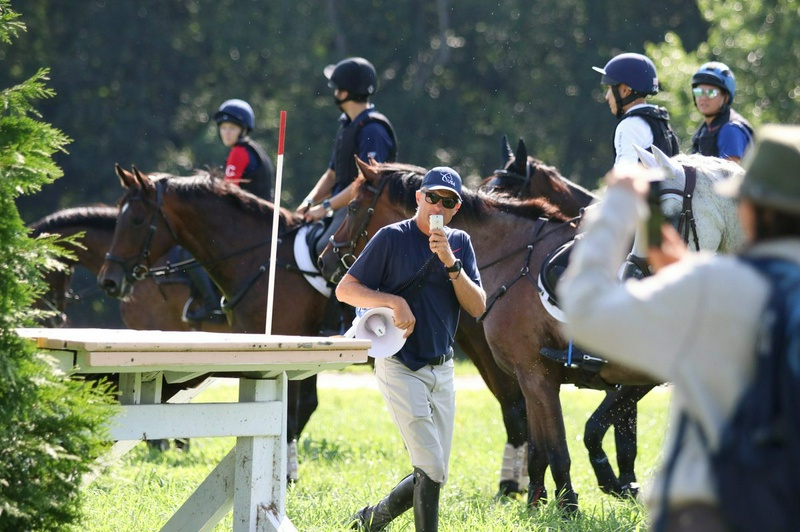
Boyd Martin, a four-time Olympic rider, praised the performances of riders who excelled with memorable phrases during a cross-country training session at the "Windurra Camp," held early August at the facility owned by him and his wife, Silva.
"You are a champion!"
"Buddy, you are truly a legend!"
"You are a star!
Give him a good pat and tell him you love him."
Alongside this positive coaching style, Martin also provided valuable insights into his approach to riding in cross-country.
In this session, Martin led a group of horse and rider combinations in the Modified/Preliminary category; a group that practiced several exercises on the cross-country course of this large facility in Cochranville, Pennsylvania.
Boyd Martin is leading a cross-country training session for the Modified/Preliminary group at Windurra Camp 2025.
After warming up on flatwork, the group's cross-country training session began with a few small obstacles, including logs, coops, roll-tops, and cabins.
Martin said, "We are getting the horses in the cross-country mindset, but these are not speed obstacles.
It's almost like warming up in show jumping.
We just want to calmly and comfortably get over these obstacles."
The pit exercise had pairs jumping from two different lines to enter and exit the pit to work on the horses' responsiveness and balance.
Martin recommended that when jumping an obstacle leading into the pit where the ground drops behind it, riders approach the obstacle with a steady rhythm and a bit slower.
Martin said, "In my opinion, some of the hardest jumps are those where the horses have a little hesitation about their landing spot.
In terms of body position, you may need to sit a bit firmer in the saddle and keep your upper body back as you approach these obstacles."
Victoria Miller and Kentza, one of Martin's former horses in five-star competitions, are going through the pit exercise.
However, he advised that when going up the slope and jumping out of the pit, the rider should add a bit of impulsion and allow the canter to remain smooth and flowing to the obstacle, rather than trying to add a step.
This usually results in a softer and more efficient ride.
He also reminded that it is better for the rider to stay with the horse's movement, as the horse may have a big jump over the obstacle when exiting the pit.
For horses that were getting quick in the pit exercise, Martin suggested that riders collect them to slow their rhythm.
On the other hand, for horses that were hesitant to jump into the pit, Martin asked riders to hold their leg, especially at the base of the obstacle, and keep their eyes fixed on the next obstacle.
He said, "When you jump from section A, try to lock your horse's eye on section B."
While it may be tempting for riders to "help" their horses with their bodies while jumping, Martin emphasized calm and still riding.
He said, "Try to keep your body as still as you can while jumping."
If pairs had any unevenness on any of the hollow jump elements, he asked them to work through the same exercise once more to make their riding smoother.
The first training session of the water obstacle course, Martin asked the pairs to jump over a cabin on the hill, then make a right turn to reach a small log at the water entry, and after that, pass over a small log at the water exit with five strides.
Then they had to make a right turn to reach a narrow white obstacle and after five strides, jump over a table in the water.
Sammy Turner and Rainstown Covergirl jump over the narrow white obstacle towards the water.
Five strides later, this pair jumps over the table in the water.
If the riders had an uneven six strides instead of five in the distance between the obstacles in the water, Martin would ask them to repeat the line, land after the obstacle in the water, and "continue smoothly"; meaning to keep the foot on the horse to easily reach five strides.
On the other hand, if the riders realized that they wanted to shorten the horse just before the second obstacle in these lines to make five strides fit, he recommended that in the second attempt, they approach the first obstacle with a more balanced rhythm.
In this exercise, the pairs initially jumped over a table and then made a right turn to reach another table.
After that, they had to jump over a left-turning open semicircle, from one rolltop to the next and then to a white table.
Martin wanted the riders to approach this series of obstacles as if they were jumping a few initial jumps of a cross-country course.
The goal was to jump the obstacles with the appropriate rhythm and from the horse's stride, without excessively altering the horse's stride to find a perfectly ideal distance.
He said, "The art of doing nothing is a hard job.
You are approaching the obstacle and trying not to look for a long distance or a short distance, but you want to bring the horse to the obstacle from the heart of its stride."
Martin suggested that riders should not attack the obstacles at maximum speed, which would then force them to severely shorten the horse just before each obstacle.
He wanted them to reach a middle and balanced pace in their Chaharnal.
Martin said, "In dressage, when you are in a medium canter, you can make the stride a bit bigger and reach an extended canter, or shorten it and go to a collected canter.
I like the idea of a medium Chaharnal.
I know it may sound strange, but what I mean is that if I want to go faster, I can, and if I want to balance it out, I can still do that."
Casey Jones and Louis Vuitton are working on going to the individual obstacles with an improper stride.
Although the obstacles were not particularly difficult, Martin emphasized the importance of practicing individual cross-country obstacles.
He said, "About 60 percent of cross-country courses consist of individual obstacles, and efficiently and smoothly jumping these individual obstacles can be challenging."
Martin said that for riders who are moving up to higher levels and jumping larger obstacles, practice plays a key role in gaining confidence.
He advised, "Without scaring yourself, you should gradually get used to jumping obstacles of significant height.
Even though you are going fast and the jumps are big, there should be an element of calmness in your riding, and this process should feel almost as if it is happening in slow motion."
Martin reminded riders working with less experienced horses to be more supportive in their use of aids and to give the horse more time to approach the jump.
Martin said that if riders encountered refusals or rejections at the jump during training, "it's not a big deal."
He suggested that if needed, riders should first jump a simpler obstacle and then return to the problematic jump for a second attempt.
The white obstacles caused a few minor issues during this training session.
Martin believes that horses often become hesitant or show slight nervousness when jumping white or off-white obstacles in cross-country due to the way they see them; therefore, they may need more supportive aids as they approach the jump.
For the skinny combination exercise, Martin asked each pair to approach the first roll-top from the opposite direction to the angled brush combination and then the white table from the opposite direction, with 6 strides to a skinny jump.
He explained that for each of his cross-country exercises, he likes to start with an easy and forgiving jump so that if riders have an unbalanced jump, they have a chance to correct it before the obstacles become more difficult.
For the table to skinny combination, Martin recommended that riders have a balanced jump at element A so that they can reach the jump at element B with the appropriate stride.
Staying straight and positioned in the middle of the flags at element B was the key point for practicing accuracy.
Jones and Louis Vuitton jump off the table and focus on the skinny jump.
They stay straight as they pass over the skinny jump and position themselves in the middle of the flags.
When one of the pairs had trouble at the skinny jump and repeatedly drifted left off the line, Martin first asked them to approach the skinny jump directly and head-on so that the horse could pass its nose between the front and back flags for better visibility.
He then asked them to jump the obstacle at an angle from left to right, using a guide rail on the left.
Martin advised them not to rely on speed to clear this jump, but rather to proceed with assertive riding while maintaining correct body position.
For the angled brush combination in the next exercise, Martin asked the pairs to reach a table with their left hand, then jump a trekhener, and after a right turn, enter an angled brush combination with a one-stride distance.
They then circled to jump a table and afterwards reached an angled brush combination with a one-stride distance with six strides.
When the pairs jumped the angled brush combination with a one-stride distance on their own, Martin advised the riders not to turn too soon and to wait until they found the right line to the obstacles.
He pointed out that angled brush obstacles are common in competitions, which is why he likes to include them in his cross-country training sessions.
Martin said, "When I am training cross-country, my goal is to never go off line. If there is a way to jump section C first, then jump B to C, and then A-B-C, I prefer that to just attacking a hard combination and messing it up. The horse knows what is coming, so it's a bit like cheating, but it works really well."
James Power and Bramble Ridge Pandar the Truth jump from the left side of the table to position themselves correctly for the angled brush combination.
They found a suitable line to enter element A of the combination with an angled brush.
This pair successfully jumps element B and completes the exercise.
In this section of the exercise, the pairs first cantered over the ditch of a half-coffin — depending on the direction of movement, the ditch became an obstacle or the obstacle became a ditch — to familiarize the horses with it.
Then they returned in the opposite direction at a counter; they jumped over the ditch and then with two strides uphill reached the roll-top of the half-coffin.
Martin explained: "Going from the ditch to the obstacle is much easier than going from the obstacle to the ditch, which is why I start the process in this way."
When the pairs practiced the half-coffin from the jump to the ditch, Martin told the riders to sit back for both elements A and B so that if their horses hesitated, they would be ready.
He reminded the riders to maintain their leg pressure if the horses became hesitant and be prepared to encourage them with a light tap of the whip.
After the pairs successfully practiced the half-coffin in both directions, they approached a set of obstacles that included a more difficult coffin, where they also had to provide the same supportive and encouraging riding to their horses.
Miller and Contessa jump element A of the half-coffin.
The pairs jumped a cabin obstacle in a curved line with five strides, towards a corner with a right turn, and then to one of two roll-tops or hanging rails and then to a narrow obstacle.
After that, they had a right turn towards the half-coffin and then with a left turn reached two small logs on the hillocks.
They completed the work with a left turn towards the coffin; including A.
Roll-top, one stride downhill to B.
A ditch, and then two strides uphill to C.
A narrow obstacle.
In the longer distances between obstacles, Martin asked the riders to canter as if they were in a competition and then "reduce" the horse's canter to pass through the half-coffin, complete coffin, and ground changes.
However, Boyd did not want the riders to adjust the horse's stride too close to the obstacles.
He said: "I want you to try to measure the jumps so that you do not adjust him in the last one or two strides; that is, if necessary, reduce speed a little earlier."
When one of the horses hesitated between A and B of the complete coffin and took two strides instead of the one-stride distance, Martin asked that pair to repeat the combination to cover that distance in one stride with bold riding; the rider should also support the horse after element A with stronger leg pressure and, if necessary, with "tickling with the spur" or a whip tap.
Martin said: "It’s quite clear that he is a bit hesitant about that ditch, so we need to teach him that when he sees that ditch, he should go."
Martin believes that coffin obstacles on varied ground are similar to ditch training; where horses are not fully confident about their landing spot and need more support from the rider's aids.
Martin's second water obstacle exercise to conclude the cross-country training session asked the pairs to jump a set of obstacles in the second water obstacle set.
Most pairs jumped the cabin obstacle with a left turn towards a hanging rail in the water, then with a returning right turn reached a chevron in the water and from there went with six short strides to a narrow obstacle in the water.
He adjusted the program for some of them based on the progress of each horse and rider throughout the session so they could finish the training with a good feeling.
While Martin asked the pairs to approach the Chevron line to the narrow obstacle with six strides and calmly, he warned the riders of powerful horses not to underestimate the narrow obstacle and not to approach it with a lack of power.
He said, "Land and maintain six stable strides."
Carly Sius and EHF Casiro Royal jump from the Chevron obstacle into the water.
This pair easily covers six strides to the narrow obstacle in the water.
Another option for the Chevron line to the narrow obstacle was to execute it in a linear fashion with a gentle curve.
Martin said, "Aim slightly to the right of the first obstacle and then help with a slight bend to find a bit more space for the second jump."
For the rider who had an uneven jump over the narrow obstacle in the water, Martin encouraged him to be more daring.
He said, "When you're a bit nervous, you need to be in a short, powerful, and aggressive canter."
Martin's final summary after all pairs successfully passed through the water obstacle course included a few final points for each of the riders about what they should work on next.
He also reviewed his cross-country training process, which includes the following: a calm jump over small obstacles to get the horse thinking about cross-country.
Designing a small course of single obstacles and increasing speed to a level suitable for the horse.
Breaking combinations into smaller parts, starting from a single element and then moving towards jumping the entire combination.
In the end, Martin wants the horses to have gained more confidence while practicing over cross-country obstacles.
He emphasizes that to achieve this goal, the rider must act calmly and empathetically.
Martin said, "It's not about being aggressive, rough, or anything like that; it's about understanding and the horse's confidence."
He added that riders who are developing their cross-country skills will be better prepared for competition if they have navigated difficult moments in training sessions.
Martin said, "There needs to be this trained behavior that 'even when everything isn't perfect, I still get the job done,' because you can't suddenly become that kind of person in a competition."
It seemed that all pairs left this cross-country training session with more confidence.
Riders who had to show resilience in less-than-ideal jumps also took this educational opportunity to improve.
With Martin's tips at Windora Camp, riders now have more skills in their cross-country toolbox for the next competition or training session.
Source: Practical Horseman – Training