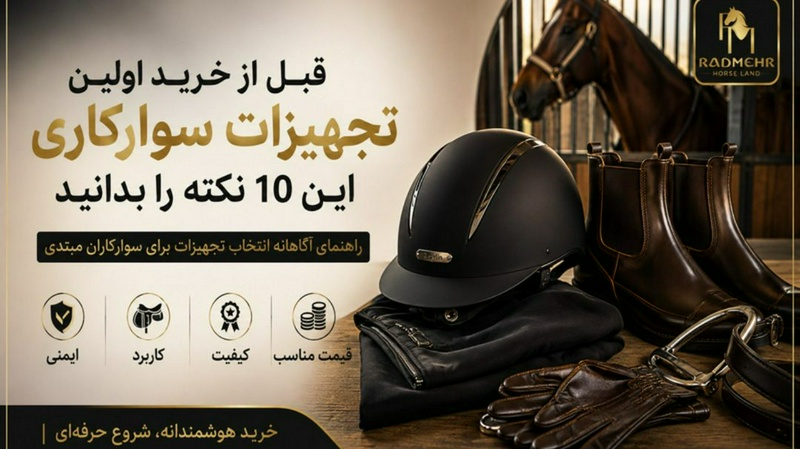
Cependant, dans cet article, nous n'allons pas tout examiner.
Notre focus est sur une section spécifique : les équipements et vêtements du cavalier.
C'est-à-dire les articles qui doivent aider à la sécurité, au confort, au contrôle et à une meilleure performance du cavalier sur le chemin de l'équitation.
Et c'est ici qu'une question importante se pose : si nous venons de commencer l'équitation, par où devons-nous exactement commencer parmi tous ces articles ?
La réponse n'est pas d'acheter tout !
La réponse est d'acheter correctement.
1.
Il n'est pas nécessaire d'acheter tout le premier jour ; apprenez l'achat progressif. Le premier principe est que les équipements n'ont pas tous la même valeur et priorité.
On peut les diviser en quatre groupes selon le moment de l'achat : Essentiel (Essential) : Équipements qui ont une importance directe pour commencer et pour la sécurité.
Utile (Useful) : Articles qui améliorent votre confort ou votre performance, mais dont l'achat peut être légèrement retardé.
Spécialisé (Specialized) : Équipements qui deviennent importants lorsque vous entrez dans une discipline ou un niveau spécifique.
Futur (Future) : Articles dont vous pourriez avoir besoin plus tard, mais dont l'achat n'est pas nécessaire pour le moment.
Donc, si vous êtes débutant, il n'est pas nécessaire de penser que tous les équipements d'un cavalier professionnel doivent être dans votre panier d'achat.
L'objectif du premier achat n'est pas de construire une garde-robe complète ; c'est de créer un bon point de départ.
2.
Casque de sécurité ; votre ligne rouge en équitation Parmi les équipements d'équitation, certains articles peuvent être reportés à plus tard ; mais quand il s'agit de protection de la tête, c'est complètement différent.
Le casque de sécurité doit être l'une des plus hautes priorités d'achat et lors de son choix, la norme de sécurité valide, l'ajustement correct et le bon système de sangle et de maintien sont d'une importance fondamentale.
Le casque doit être correctement ajusté sur la tête et correspondre à la taille et à la forme de votre tête ; ni trop lâche pour bouger, ni trop serré pour être inconfortable à porter.
3.
Les bottines d'équitation ne sont pas seulement pour l'esthétique Les bottines d'équitation sont l'un des équipements qui sont parfois vues à tort uniquement sous l'angle esthétique.
Alors que les chaussures appropriées doivent être compatibles avec les conditions d'équitation et la position du pied dans l'étrier.
Un talon approprié et une semelle adéquate sont des caractéristiques à prendre en compte lors du choix.
Les chaussures ordinaires peuvent être parfaitement adaptées à un usage quotidien, mais ne sont pas nécessairement conçues pour l'équitation.
Alors, lors du choix des chaussures, ne demandez pas seulement : « Quel modèle est le plus joli ?
» La meilleure question est : « Quel modèle est le plus sûr et le plus fonctionnel pour mon équitation ?
» 4.
Pantalon d'équitation ; confort, friction et contrôle Le pantalon d'équitation n'est pas seulement une version plus élégante d'un pantalon ordinaire.
Son design est tel qu'il est plus en phase avec les conditions de position sur la selle et le mouvement du cavalier.
Lors du choix du pantalon, la liberté de mouvement, le confort et le niveau de friction avec la selle sont importants.
L'une des caractéristiques importantes de certains pantalons d'équitation est le Grip ; des sections conçues pour créer plus de friction et aider à la stabilité du cavalier.
Pour cette raison, un pantalon approprié peut être plus qu'un simple choix vestimentaire et jouer un rôle dans le confort et la stabilité du cavalier.
Ainsi, choisissez votre pantalon d'équitation comme les autres équipements, en fonction de l'utilisation ; pas seulement de l'apparence.
5.
Guêtres ou Half Chaps ?
Votre choix dépend aussi de vos chaussures. L'un des conseils pratiques lors de l'achat d'équipements est que certains articles doivent être choisis ensemble.
Les guêtres ou Half Chaps en sont un bon exemple.
Si vous utilisez des Paddock Boots, vous pouvez les associer à des Half Chaps pour obtenir une combinaison pratique pour couvrir et protéger le bas de la jambe.
En fait, le choix entre des bottes hautes et la combinaison de bottes courtes avec des Half Chaps n'est pas seulement une question d'apparence.
Donc, si vous envisagez d'acheter des guêtres, pensez d'abord à ceci : « Avec quel équipement mes chaussures seront-elles utilisées ? »
Cette approche simple peut éviter des achats incohérents.
6.
Gants : meilleur contrôle, moins de blessures Les gants peuvent sembler petits comparés au casque ou aux bottes, mais ils sont directement liés au contrôle des rênes.
Une paire de gants appropriée peut protéger les mains tout en aidant à mieux contrôler les rênes grâce à une bonne adhérence.
C'est pourquoi, lors de l'achat, ne vous concentrez pas uniquement sur l'apparence des gants.
La partie intérieure est également très importante, car la qualité et le type d'adhérence peuvent affecter le niveau de contrôle.
En fin de compte, des gants appropriés doivent répondre simultanément à trois besoins : protection, confort et contrôle.
7.
Vos équipements doivent être en harmonie avec votre parcours équestre L'une des erreurs les plus importantes est de penser que tous les cavaliers ont besoin du même ensemble d'équipements.
Alors que votre parcours équestre modifie les équipements dont vous avez besoin.
Pour un cavalier débutant dans un manège, l'accent principal peut être mis sur la sécurité de base, un casque approprié, des bottes appropriées et le confort.
En saut d'obstacles, les équipements de protection et la liberté de mouvement deviennent plus importants.
En dressage, des équipements comme les pantalons Full Seat pour plus de stabilité et les bottes hautes officielles prennent plus d'importance.
Et dans l'équitation de loisir ou de randonnée, des facteurs comme la résistance aux conditions environnementales, le confort sur de longues distances et le casque de sécurité deviennent plus importants.
Il est donc préférable, avant d'acheter des équipements spécialisés, de vous demander d'abord : quel type d'équitation vais-je pratiquer ?
Car plus votre parcours est clair, plus le choix des équipements sera précis.
8.
Gilet de protection : quand en avons-nous besoin ?
Le gilet de protection ou Body Protector est conçu pour aider à réduire l'intensité des impacts et protéger la partie centrale du corps.
Cependant, son utilisation dépend des conditions d'activité.
Dans des disciplines comme le saut d'obstacles et le cross-country où le risque de chute et de collision est plus élevé, le gilet de protection devient plus important.
En revanche, en équitation de base et de loisir, son utilisation n'est pas également obligatoire et peut dépendre des conditions, du niveau d'activité et du degré de risque.
Si vous décidez d'acheter un gilet de protection, prenez son choix aussi sérieusement que celui d'un casque.
Une norme de sécurité reconnue, comme le BETA Level 3, et un bon ajustement sont des points importants.
Le gilet de protection n'est pas censé remplacer l'entraînement et les compétences ; il peut cependant offrir une couche de protection supplémentaire dans des conditions appropriées.
9.
Un vêtement approprié n'est pas nécessairement le plus cher Nous arrivons ici à l'un des pièges les plus importants lors de l'achat d'équipements : un prix plus élevé ne signifie pas toujours un meilleur choix.
Lors du choix de l'équipement, plusieurs critères doivent être examinés simultanément : sécurité, performance, confort, qualité et prix.
La marque peut également être un des critères de sélection, mais elle ne doit pas vous faire oublier vos besoins réels.
Parfois, un équipement coûteux peut être trop spécialisé pour votre niveau actuel ; alors qu'une option plus appropriée et économique pourrait parfaitement répondre à vos besoins actuels.
Donc, si vous avez un budget limité, répartissez-le intelligemment : d'abord la sécurité et les besoins principaux, ensuite les équipements complémentaires et spécialisés.
10.
Avant d'acheter, définissez vos priorités ; ne vous contentez pas de remplir votre panier. Maintenant, nous arrivons à la question la plus importante : parmi tous ces articles, lequel acheter en premier ?
Une méthode simple est de vous poser quelques questions avant chaque achat : cet article est-il directement lié à ma sécurité ?
Si la réponse est oui, il est probablement prioritaire.
Si la réponse est non, demandez-vous : cet article est-il utile pour mon niveau et ma discipline actuels ?
Si la réponse est encore non, peut-être que cet achat peut attendre la prochaine étape de votre parcours.
C'est la logique de l'achat par étapes : tout ce que vous voyez n'est pas nécessairement ce dont vous avez besoin aujourd'hui.
Le monde de l'équipement équestre est bien plus vaste que les vêtements de cavalier et inclut des domaines tels que l'équipement du cheval, le club, le manège, l'écurie et d'autres équipements spécialisés.
Cependant, pour un cavalier débutant, acheter tout l'équipement dès le premier jour n'est ni nécessaire ni logique.
Il est préférable de choisir l'équipement par étapes et en fonction des besoins réels.
Le casque de sécurité standard est la priorité la plus élevée et ensuite, les chaussures appropriées et d'autres équipements essentiels doivent être choisis en fonction des conditions du cavalier.
Les pantalons, guêtres et gants doivent également être choisis en fonction du confort, du contrôle et de la coordination avec les autres équipements.
Avec la définition du parcours équestre, le besoin d'équipements plus spécialisés se précise également ; par exemple, en saut d'obstacles, le gilet de protection devient plus important et le dressage ou l'équitation de loisir ont également des besoins différents.
En fin de compte, le meilleur équipement n'est pas nécessairement le plus cher ; c'est celui qui est choisi pour le bon besoin, au bon moment et avec la bonne priorité.
Conclusion : pour commencer l'équitation, tout n'est pas nécessaire. L'équitation ne peut pas être mesurée par le nombre d'équipements que nous avons dans notre placard.
Un cavalier débutant peut ne pas encore avoir de bottes de compétition officielles, de vêtements spécialisés ou des dizaines d'autres articles ; mais s'il a choisi un casque approprié, des chaussures correctes et un équipement adapté à son niveau et à son parcours, il a fait ses premiers pas intelligemment.
Il n'est pas nécessaire d'acheter tout l'équipement nécessaire dès le premier jour.
Il suffit de savoir quelle est la prochaine étape.
Alors, avant chaque achat, prenez un moment pour vous demander : « Ai-je vraiment besoin de cet article, ou est-ce que je pense simplement qu'un cavalier devrait l'avoir ? »
Cette simple question peut faire la différence entre un achat impulsif et un choix professionnel.
Parce que dans le monde de l'équitation, être professionnel ne commence pas par avoir plus d'équipements ; cela commence par choisir le bon équipement au bon moment.