8 Tips for Excelling in Hunter Flat and Equitation Classes
Question: Can you provide advice on how to stand out and attract the judges' attention in Hunter and Equitation Under Saddle classes when the class is crowded and competition is intense?
~ Molly K.
, Michigan Answer: From the moment you enter the show ring for an Under Saddle class, you need to present yourself and your horse in the best possible way.
To achieve this, you need to ensure that the judge sees you as much as possible.
Especially in Hunter Under Saddle classes, your horse also needs to perform and move in the best condition.
According to the Hunter section in the United States Equestrian Federation rulebook, this means "horses should be obedient, alert, responsive, and move freely."
But keep in mind that to be competitive in Hunter Under Saddle classes, your horse doesn't need to have the best movement.
Most judges are looking for a complete package.
Does your horse show that riding it is enjoyable?
Are its ears forward?
Are its steps balanced?
Are your transitions smooth and fluid?
How well you present your horse so that these small but very important details are seen can have a big impact on the judge's final decision.
Here, Stacia Klein Madden, a member of the Prac team and one of the most successful young rider trainers across the country, offers eight important tips to shine in Under Saddle classes even if your horse's movement isn't ideal.
1.
Know Your Class Although this point may seem obvious, you need to know exactly which flat class you are competing in.
Klein Madden explained: "In Hunter Under Saddle classes, it's your horse that is judged, and you ride with lighter contact and a lighter seat.
In flat Equitation classes, the rider is judged, so the focus will be more on correct contact and correct seat.
You should work your horse more on the bit and with an upright seat and ride in the canter with a full seat."
2.
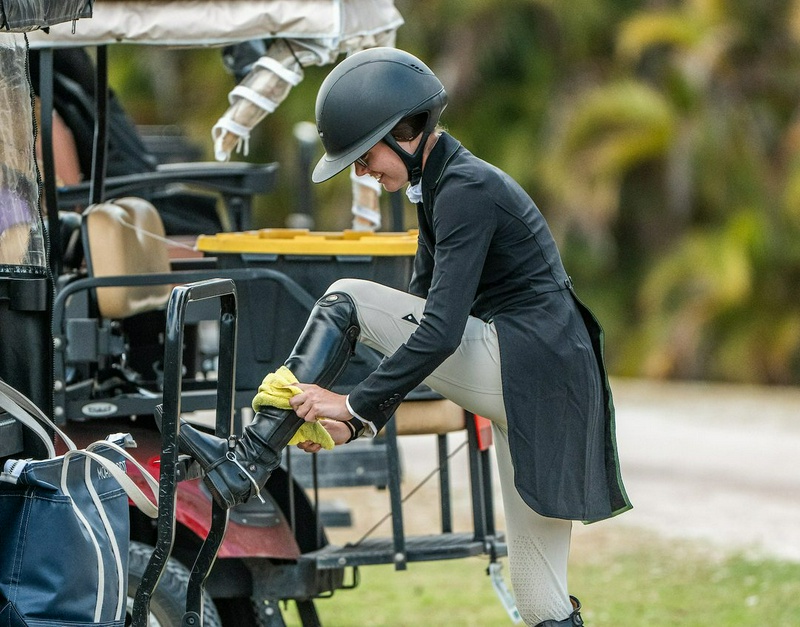
Pay Attention to Grooming If you haven't cared enough to take the time to polish your boots, clean your gear, or properly tuck your hair into your helmet, why should the judges take you seriously?
Klein Madden says that standard and appropriate grooming and overall presentation are equally important for both the horse and the rider in Under Saddle classes.
She said: "For example, if you use an old and unsightly saddle pad or if your horse's mane braids are messy and frayed, I note this in my judging card."
Although judges are not looking for riders with the most expensive gear or show attire, they want to see riders presenting themselves neatly and traditionally in both Hunter and Equitation Under Saddle classes.
First, show the judges that you care enough about how you present yourself and have put in the effort.
After that, it's time for your performance.
3.
Adjust Your Number As soon as the announcer calls your under-saddle class, according to Klein Madden, move your competition number to the outside hip so the judge can see it.
(If the judge is on the inside of the ring, move the number to the inside hip.)
When the direction of movement changes, move the number to the other side.
This makes you appear more prepared and professional.
In addition, especially in a crowded class, it can make a big difference in helping the judges find you.
4.
Use your time wisely before your class. Enter the arena well before the class starts to identify the judges' positions and ensure you can have good passes in front of them.
Klein Madden says that from a judge's perspective, when riders use their time effectively before the official start of the flat class, it is commendable.
He noted: "This allows you to find the judges' positions to ensure you can have good passes in front of them and not unintentionally hide behind other riders from view.
" He added: "If someone overtakes you and ultimately covers the judges' view, they can no longer see your number and will just move on to the next rider.
" 5.
Pay attention to the traffic in the arena. Being aware of where other horse and rider combinations are in the arena is important for various reasons.
Klein Madden says your chance of securing a good place largely depends on whether the judge has the opportunity to see you and your horse clearly.
In any flat class, it is essential to stay aware of the traffic in the ring to ensure your safety and that of other riders, as well as to give the judges the opportunity to see you and your horse.
Depending on how crowded the arena is, try to find a place where you are somewhat distanced from other horses.
This might mean using the quarter line.
Or if you are trotting on the opposite side of the judge and see that no horse is passing in front of them, you can circle in the middle of the arena to have an additional pass in front of the judge.
Klein Madden recommended that if another horse is acting up or showing restlessness, even if it means losing your ideal position in the ring, do not get too close to it, as it could create a bigger problem.
If your own horse is causing issues in the ring, the same applies.
He said: "If your horse is misbehaving, try not to cause trouble for other riders.
If you make such a mistake, you will likely be penalized, as there is really no good solution to resolve the situation.
So be considerate of others and stay alert to what is happening around you.
" 6.
Choose your position strategically in comparison to well-moving horses, especially in a class where the competition is very tight, it is important to have a strategy for your positioning relative to the well-moving horses you are competing against.
Klein Madden says you should always have a plan for where you will be in the ring relative to your competitors.
He suggested: "When there is a competitor in the class with whom you usually have a close competition — and you are also riding a high-level horse and are confident you can really shine in front of the judges — it might be better to place your horse right in front of or behind them so the judges can easily compare the two of you.
" On the other hand, if your horse is not among the best-moving horses, it might be better to keep yourself separate from other well-moving horses to attract the judges' attention on your own.
7.
Be smart in the ring Although Klein Madden doesn't necessarily like riders who "constantly circle in the middle of the field" — meaning they repeatedly turn in the middle of the field to attract the judges' attention — she likes to see riders who act intelligently in the ring.
She said: "If you need to circle in the middle of the ring because there's a good open space on the other side where you might be seen better, or because there's a crowd of horses in front of you, it's perfectly acceptable and something I expect.
" 8.
Don't be afraid to show off Both equitation and hunter classes are disciplines based on presentation and display; therefore, do your best to make your horse shine and really show the judges what abilities it has.
Klein Madden said: "In my opinion, being a little ambitious in a flat class and trying to make a few good passes to show the judges that you expect to be seen is indicative of good showmanship.
In some cases, this might even put you ahead of another top combination.
" Summary Even if your horse is not one of the best movers, learning how to showcase its abilities well in under saddle classes is a valuable skill in competition.
Good performance in under saddle classes has become more important because several major equestrian competitions have reduced the number of jumping classes in a section from 4 to 3, which has highlighted the role of the flat class.
Sometimes just being able to get a fifth or sixth place ribbon in the flat gives you the necessary points to win the championship tricolor.
Therefore, even if your horse doesn't have the best movement or isn't yet at the blue ribbon level, learning to perform well in the flat is a valuable competitive skill.
About Stacia Klein Madden Stacia Klein Madden, recognized as one of the most successful young rider trainers in this country, began her professional career after success in the junior ranks; she won the 1987 ASPCA Maclay National Championship and placed in the USEF National Hunter Seat Medal Finals and the USEF Show Jumping Talent Search Finals East.
She turned professional in 1988 and started her career at Beacon Hill Show Stables, a facility now located in Colts Neck, New Jersey.
Madden also worked for Johnny Barker in North Carolina for a time before returning to Beacon Hill, where she began teaching and developed an interest in working with young riders and matching them with suitable horses.
To read Stacia Klein Madden's full biography on Team Prac, including her major professional achievements, favorite horses, and interesting facts about this prominent hunter and equitation trainer and experienced horsewoman, click here.
Have a training question?
Team Prac — a group of top trainers in hunter, show jumping, eventing, and dressage — is here to offer practical and impactful advice to help you advance in your specialty and build a harmonious partnership with your horse.
To learn how to submit your questions to the members of Team Prac, see here.
To learn more about Stacia Klein Madden's training program at Beacon Hill Show Stables, see here.
Source: Practical Horseman – Training