Adjust the warm-up for dressage according to each horse.
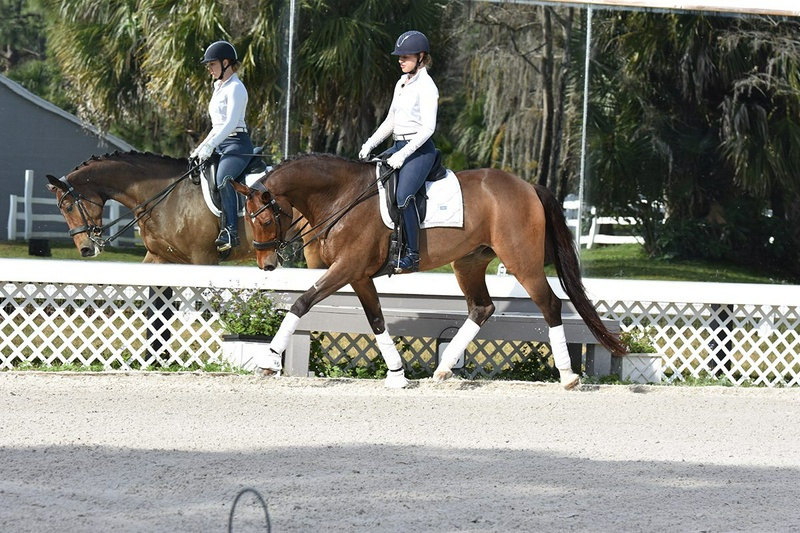
The goal of warming up with any horse, regardless of their level, is to have the horse focused, responsive to my aids, and physically prepared for the work ahead.
This sets the tone and standard for the rest of the ride.
Only when I feel the horse is available and rideable for me do I move on to new or more challenging exercises.
Physically, the warm-up should prepare the muscles for the movements the horse will perform later during the ride.
I want the horse to become softer, more connected, and more balanced in its movement as the work progresses.
There is no fixed version of warming up; I do not have a set program for warming up that I apply to all horses.
Horses are different from one another, and the warm-up should be tailored to that specific horse on that particular day.
This depends on knowing the horse, understanding its body, and paying attention to what it tells you.
Sometimes my entire ride may just be the warm-up.
Other times I feel I can execute a test after just two minutes.
An older or stiffer horse may need more time to loosen its body.
Another horse might need more structure and guidance right from the start.
Some horses feel better when I go into canter relatively early on both reins; because canter creates more wave and rhythmic oscillation in the back compared to trot, helping them to loosen their bodies.
Even with a horse that benefits from early canter, I still give it enough time at walk for its body to get moving, and I like to do a bit of trot as well to check its mood and feeling before moving on to the next phase.
The horse's mind, physical readiness, age, and level of training all affect the warm-up strategy.
A horse at the training level has a simpler warm-up than a horse at higher levels; a horse that has more power and ability.
The goal is not to go through a specific list of exercises one by one.
The goal is to understand what the horse needs to prepare for the work.
A successful warm-up begins with listening to the horse under your saddle.
Instead of following a rigid and unchangeable program, assess its rhythm, responsiveness, softness, and connection, and then choose exercises that prepare it for the work ahead.
Set the standard from the very beginning; every interaction you have with the horse matters, including what happens before fully entering the flow of riding.
I pay attention to the horse's reaction on the ground and next to the mounting block.
If I ask it to stand, I want it to stand quietly until I ask it to move forward.
Stand means stand.
The same applies when I move away from the mounting block.
When I give the leg aid, it should move forward.
If it does not respond, I clarify the aid to get the reaction I want and then return to the lightest aid possible.
I like to see the gradual increase in the intensity of the aids like this: "Please" – request with the seat bone "Do it" – emphasis with the leg aid "Right now" – use of the ankle or heel "Oh dear"; reinforce the aid with a spur or whip "Please" starts with the lightest aid; that is, a request with the seat bone.
If I do not get a response, "Do it" is added with the leg aid.
If I still need a clearer response, "Now" means the ankle or heel comes into play.
And if the horse still does not respond, "Oh dear" can mean that I reinforce the aid with a spur or whip.
The goal is not to keep acting stronger and stronger or to ride with more emotions.
The goal is to give the signal clearly, get the response, and then immediately return to "please."
I also want the horse's attention on me.
It is completely natural for him to notice something unusual outside the arena, but I do not want him to turn his head away from the work or stop paying attention to me.
If I establish from the very beginning that my aids are important, when I start to ask for more difficult requests, I am much more likely to have his attention.
Moving forward, building connection and attention gives me a lot of information.
I want the walk to be active and with a progressive rhythm, but at the same time, I want the horse to use his body, not just to go around with a stretched neck and a hollow back.
I ask him to be rounder and to move towards connection to start working on the top line of his body.
My job is to stay upright, balanced, and with him.
I want my seat to follow the walk, not to push it at every step, and I want my elbows to be soft enough to follow the horse's mouth with the forward and downward movement of his neck.
If the rider's hands are stiff, the contact will also be stiff.
I want an elastic connection that allows the horse to move towards the reins without being held in it.
The walk is an opportunity to assess how the horse feels before asking for more difficult work.
Look for a purposeful and progressive rhythm and see a horse that, while maintaining calmness and connection, responds willingly to light aids.
With lateral work, find what needs assistance. When I reach a forward step with connection, I often use lateral work to check how the horse responds to my aids in different directions.
This can include leg yield, leg yield with the head towards the wall, shoulder-in, or haunches-in.
Lateral work helps me feel where the horse is soft and flexible, where he is stiff, and whether I can influence different parts of his body or not.
My leg does not always mean forward movement.
Sometimes I ask the horse to move his whole body sideways.
Sometimes I want the hip, chest, or shoulder.
Sometimes I want the hind legs to react faster.
For some horses, before I go for a lot of lateral work at the walk, I work a bit in trot and canter.
Again, everything depends on the horse itself.
But I like to have the option to return to the walk whenever necessary to clarify an aid or simplify a point.
For example, if I ask the horse for a counter canter and he gets confused or makes a mistake, I might return to the counter canter in the walk.
There, I can show him where I want his legs to land and how his body should bend; then, when he understands the topic, I try again in canter.
Lateral work clearly reveals the differences in flexibility, balance, and responsiveness between the two sides of the horse's body.
Request the movement with clear and precise aids, then allow the horse to maintain that movement without constantly pushing or holding him forward at every step.
When you request lateral movements, apply the aid and then allow the horse to carry that movement himself.
Do not insist constantly.
If you have to constantly push him forward with your foot and hold him with your hand, this exercise is of no benefit to you or your horse.
With more advanced horses, I like to connect lateral movements.
I might ask him: "Can you bring your hips in?
Can you bring your shoulders in?
Can I turn you?
Can I move you sideways?"
I want the exercises to be fluid and continuous while also noticing where the horse feels stuck.
This shows me which part of his body needs more gymnastic work.
The spiral movement reveals a lot; the three-loop spiral is one of my favorite exercises because it gives you a lot of information about the horse's feel on both sides of his body.
This exercise is also very useful at lower levels, as it can reveal many of the same points that more advanced lateral work uncovers.
Consider each loop as a semicircle with a moment of straightening on the center line.
Then, when you turn to the new direction, change the bend.
In this case, you can feel how sincerely the horse bends around the inside leg, how straight he stays on the center line, and whether one direction feels easier for him than the other.
This exercise also helps you check balance.
Does he lean on the inside shoulder?
Does he fall out of the line of movement?
Is the change of bend soft and fluid, or does one side feel significantly harder?
You can also add transitions between movements to this exercise.
When you cross the center line, walk or stop, then try the same transition from walk to stop while the horse is on the bend.
You can also increase the number of loops to measure your accuracy.
This exercise can remain simple or become more challenging depending on the horse's needs.
Use transitions between movements to assess responsiveness; transitional changes within a stride and between strides is another way I evaluate whether the horse is truly responding to my aids or not.
When I ask for a canter from walk, I expect a clear and quick response to my leg.
When I return to walk, I want the same energy and intent to move forward to be maintained.
I think of downward transitions like changing gears, not turning off the engine.
The energy should still flow forward.
The horse should move freely forward during the transition, without losing the driving force, becoming abrupt and stiff, or stopping the forward movement.
The same idea applies to transitions within the same stride.
I might go from a more open working canter to a collected canter and then send the horse forward again.
When the horse sits more in the canter, he transfers more pressure to the ground, bends the joints of the hindquarters more, and carries more weight on the hind limbs.
This demands a lot from him; that’s why I want both sides of this spectrum.
The horse should be able to go forward when I ask him, and at the same time, he should be able to come back, sit, and collect without losing rhythm or connection.
Transitions within the canter help develop responsiveness and balance.
Ask the horse to lengthen or shorten his strides while maintaining a steady rhythm and connection; not letting energy dissipate when coming back.
Get ready for the canter and collection. In the canter, my job is to support the horse by keeping my body straight, aligned, and balanced.
I want a gentle pressure from the calf to bring the hind legs more underneath the body while the shoulders wait.
If the horse appears stretched and disconnected, I might use a deeper seat and closed calf to connect to my hand.
From there, I can make small adjustments in flexion, body alignment, or response to the calf, but the quality of the canter must remain the same.
The rhythm should feel steady, like a metronome.
No matter what I want, I must not lose the fundamental quality of the movement.
In the canter, the alignment of the body and the balance of the rider are of utmost importance.
Maintain a steady rhythm and simultaneously encourage the hind legs to step further underneath the body with the calf, so the horse maintains its continuity without rushing forward.
Let the warm-up change the plan; depending on the horse, you might spend the entire ride working on something that was initially just supposed to be a warm-up, and that's perfectly fine.
Training is not a straight, unerring path.
My plan might be to work on canter zigzags, but during the warm-up, I realize the horse is not moving well enough from one leg.
Instead of just moving forward because the initial plan was this, I might spend the entire session working on leg yield at the walk.
This is still a valuable exercise.
In fact, I am working precisely on the same component that the horse will need for better execution of the canter zigzag on another day.
The warm-up is not something to rush through before starting the "main work."
The warm-up is where it becomes clear what the main work really needs to be.
Sometimes the warm-up itself is the main exercise.
This process, no matter how long it takes, must be followed, and returning to the basics is always worthwhile.
It is these basics that make performing more complex dressage movements easier for the horse and watching them more beautiful.
About Laura Ashley Killian Laura Ashley Killian ©Gold Horse Media Laura Ashley Killian, a Grand Prix dressage rider and trainer, is a holder of gold, silver, and bronze USDF medals and has silver and bronze ribbons in freestyle as well.
Killian is also a USDF certified instructor/trainer up to fourth level and has completed the USDF "L" judging course.
She teaches and trains year-round in Loxahatchee, Florida.
To read more articles by Killian, click here.
Sources and attachments: Laura Ashley Killian Source: Practical Horseman – Training