Educational clinic with Helen Langehanenberg, multiple medal winner for Germany
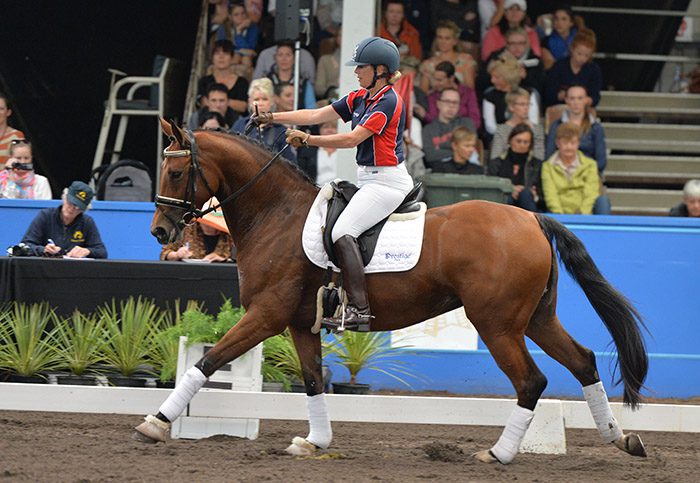
Report and photos by Ute Raabe, Ros Neave and Rebecca Ashton from a training class with multiple medal winner for Germany, Helen Langehanenberg, enjoy.
Helen talks about feel, precision and the importance of the horse knowing what we want.
.
.
She said: “We want our horse to be collected, in a high position and on the bit, but we also want to feel our horse and for our horse to feel us, dressage must be a partnership.
” Helen and Damon Hill demonstrate The first horse in the arena was Yarramee Poetry, a four-year-old mare by Royal Hit, owned and ridden by Sharyn McCombe.
She said: “Take your time, don’t worry about her neck being too high.
You want to feel the connection.
From tail to neck we want the same suppleness and bend.
Even if she is hot, ask her to work from behind.
” She said: “Ask her to stay with you, keep the contact until she is ready to stay with your pace.
When you feel she starts to stretch, give a little rein, but only enough for her to follow.
Talk to her, she has to learn to trust the rider.
Then she will relax, because she knows her rider will take care of her.
” She said: “When you can feel the contact, continue for one or two laps, so the horse can experience that feeling in her body.
If you changed something, for example asked for bend and shortened the rein on one side, hold the bend for a moment, to give your horse a chance to understand what the rider wants.
” She said: “You want to feel the connection.
From tail to neck we want the same suppleness and bend.
” Helen and Damon Hill in the European Championships next Reventon (from Regazzo), a former competition horse, and Georgia Connolly is.
She said: “There is no right or wrong way to start a work session, it depends on the horse.
” She said: “If your horse loves trot, start with trot work.
With this horse we decided to start with trot work, he has already warmed up, so with small transitions we try to improve his trot work.
” She said: “Work less with your hand, sit quietly, use your leg to collect him.
Just a normal working trot, sit, close your leg, keep the contact, and from this closed leg aid ask the horse to collect himself, move more under the center of gravity and carry more weight.
” She said: “From here we can start the lateral work, first shoulder-in.
With bend and flexion from the corner, move into shoulder-in and drive to the outside rein.
” Helen on the way to victory in the Bundeschampionships with Fürst Khevenhüille, son of Florestan She said: “In the corner I should see three legs if I look from the front: the outside foreleg should cover the inside hind leg, first make a small circle in the corner to create suppleness.
” She said: “Don’t always ride on the long side, you can look at a point at the end of the arena and ride to that point so you both learn to balance on a free line.
” She said: “When teaching half-pass, we first do the leg yield and crossing of the horse’s legs, then we do the bend exercise.
Then we put this puzzle together.
We do not start the half-pass like this, by saying, “I want to go there, I need flexibility here”; the horse may move sideways, but there will be a big question mark in its eyes and it will say, “What am I supposed to do?
”» he said: “In Qatar, ride with the haunches-in movement; this way you can play with the horse and make learning the half-pass easier for it.
Choose your line and then, step by step, build a half-pass from it.
” Boronia and Elliott focus on changes with Boronia (Breitling), who has recently come in and is ridden by Elliott Patterson, the focus is on training flying changes.
Helen and Damon Hill show it he said: “Practice the changes from the circle, through the circle, counter-canter, do this in different positions so that your horse does not wait for the movement.
Use the short sides and the corners; this is your time to prepare.
Always work between the changes, try to improve the counter-canter between the changes.
” Helen emphasizes that it is important to have a plan for what you want to do before every ride.
She said: “Think about what you want to do, and if your horse was good, do not continue to the next exercise or movement.
Keep the horse fresh and motivated.
” Damon Hill and Helen show us the change Rocaille and Sara start with haunches-in We see this principle in Rocaille, an eight-year-old Oldenburger mare by Rubinero who competes at the medium/advanced level with Sara McDonald.
Rocaille gets tired quickly and so Helen has decided to start with movements that are difficult for her, namely pirouette work.
She said: “Start with haunches-in.
Ask for less collection, make the work less difficult, explain to her how to use her body.
The inside hind leg now steps a little sideways, but later for the pirouette, it can easily step under the center of gravity.
We do not want the horse to lean to one side when it steps sideways.
We want our horses to be round and around our inside leg, in an active collected counter or even work.
” Helen talks about her star, Damsey She said: “I think Damsey is the king of pirouettes.
I always feel that when I go in, I can do 50 pirouettes.
He doesn’t care, he just does it…
” She said: “Do not look for perfection on the first attempt, but rather aim to explain the movement to the horse.
Stay soft and release the inside rein, but remain in flexion and bend and keep the aids going until the horse is ready to do the movement and understands what the rider wants.
It may not be perfect, but you should feel that the horse is trying.
” Helen and a young Silberster show a stretch She said: “That is also something I like, maintaining contact and working with the horse like a young horse between exercises, let him stretch forward, make the work easier for him, he has an active break in the canter movement.
” She said: “Now bring him back up again, always ask the horse to react to an aid and then keep him sensitive.
Say ‘I am here’ once; a horse that reacts immediately has received a clear aid.
Otherwise, the horse asks, ‘What does my rider want to do’, and starts to dominate, and that is where the problems begin.”
Clear aids, clear leadership, the horse knows what to do and then enjoys doing it.
» Sara with the Haches-in movement circles Helen in a small circle.
She said: «Start with suppleness and bend first.
When you feel that your horse is resisting the bit, keep the bend, but do not pull back.
At that moment, ask for more activity from the horse’s hind end so the horse can take to the bend.
The more you collect, the more you want to feel the leap in the canter stride, three-beat.
» She said: «When you transition from canter to walk, go through a three-beat, do not stop with a hard transition and all the legs hitting the ground heavily.
Ride a soft transition; you want to feel the three-beat.
Feel that the last canter stride is a proper canter stride, and then you have a four-beat in the walk.
» She said: «Now give the reins completely to him so he can find a position for his neck in which he is relaxed.
When you go back to working trot and the mare gets tired, you can let her not be fully up in this position, but still work if you want to improve her posture and make her stronger.
Let her find a contact in which she feels good.
» She said: «Always give them days off; do not practice dressage movements seven days a week.
You can do a bit of jumping, go for a hack, give them different ideas for using their bodies.
Keep it interesting.
» Next Helen talks about passage with Anthony Bartlett: She said: «It is very important, always do not go straight down the track, move in a circle or on large lines in the arena so you always bend him and ask for more suppleness and activity.
Take this with you into collection.
Now move on to passage work, keep the hands in front of you.
» She said: «Play with passage, collect the passage and come out of passage.
Step by step you can improve it, work from behind and pull him into passage to improve the two-beat.
» Helen and Damon Hill in Neumünster show a winning movement she said: «From here we can start working on piaffe.
I always like to start this from working trot at first.
Trot–piaffe–trot–piaffe.
Use the energy of the trot to go into piaffe and after each one, make quick transitions.
Make him quick with your seat and think about extension in the piaffe.
» The final center line at the London Games.
.
.
She said: «If the horse turns a little in piaffe, let him, he is learning.
You want something and you give them something.
Play with piaffe work and passage, turn it into a game.
Activate him through quick transitions, not by continuously pushing.
This will make him respond more softly and become more sensitive.
Transitions are an important part, not piaffe alone.
» Shanon and Ambassi in the Grand Prix competitions, the last pair we see is the KWPN gelding named Ambassi (Samba Hit) and Shanon McKimmie competing in the Grand Prix.
She said: «From easy to hard, start with a long half-pass in canter across the diagonal, do the same to the right, jump inward.
» She said: «When you practice these zig-zag half-passes, you should feel that they belong together.
There should be a smooth transition from right to left and from left to right.
When you go into right counter-canter, you can bend to the left, but continue counter-cantering to the right until you feel the point of balance: go straight and, at that moment, make the flying change.
You already have the suppleness and bend for the new direction, you can move smoothly into the new direction with the new inside hand and leg leading to support the horse.
» he said: «The Grand Prix test requires five half-passes to each side of the center line with one flying change at each change of direction; the first and last half-pass are three strides, the rest are six strides.
You have to count the counter-canter strides; the change is the first counter-canter stride toward the new direction.
» then a bit of pirouette work.
.
.
he said: «Although you collect, you still want to feel the counter-canter jump, the inside leg must leap deeply under the center of gravity, not shorten; you must feel the same rhythm.
In a working pirouette, you jump around the inside hind leg.
No matter how small you become, you must always feel that you are counter-cantering around something, even if you imagine a very small plate.
Keep the tendency forward; if he comes behind the leg, go forward.
» he said: «Change your routine; always do the pirouette in a different way.
Go to the center line and start with the idea of a working pirouette, then after the big start, become very small.
You can change the horse during the pirouette; this exercise is really good because it gives you security for the test.
» he said: «This is what I like about this horse; he tries.
» If you see him walking on a long rein, it doesn’t look as if he has a complete body.
He is tall, his body is short, his neck is too deep and not round enough as you would like.
But when Shanon shortens the rein, he has no weakness.
He can work completely with his body and has the ability to carry weight.
A good body structure helps, but it really depends on the horse itself.
He said: «I like to bring my horses back to the stable while they are still fresh.
They can sweat, but the muscles should not be tired; they should not feel ‘not again’, but rather ‘oh, we can do something else’.
I prefer them to be eager for the next day and to look forward to their work with enthusiasm.
» current star, another representative of the D line, Damsey Do you want to breed a dressage horse from the D line?
How do you find the best producer of all – De Niro – go to www.
ihb.
com.
au.
Or Danciero?
Source: The Horse Magazine