How to execute a complete flying change
Jane Savoie, the American dressage rider, trainer, and author who died in December 2020, explains how to ride a flying change and what skills should be established in the horse before teaching this movement. To learn how to ride a flying change, you first need to know what the movement is.
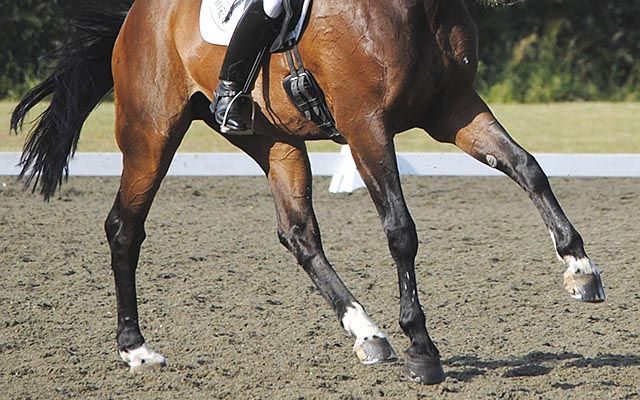
In a flying change, the horse remains in canter but changes the canter lead at the moment of suspension, that is, when all four hooves are off the ground.
In dressage competitions, it is important that the change is performed cleanly and that both the forehand and hindquarters change at the same moment of suspension.
One common mistake is for the horse to first change with the forehand in one stride and then with the hindquarters in the next stride.
This matters less in jumping, but the sooner the change is completed, the less the balance of the canter is lost.
Approaching a fence with an unbalanced canter does not give the horse the best chance of clearing that obstacle cleanly and without a penalty.
Preparing for flying changes before you want to teach the horse a flying change, he should be able to: perform a good simple change of lead (canter/walk/canter).
The downward transition should end in a clear, definite walk, without stray trot steps.
Before asking for the transition, make the canter more collected with collecting half halts.
If the horse moves too quickly, he will lose his balance on the forehand in the downward transition.
The upward transition should be quick and responsive to the leg, without becoming rushed or explosive.
Be balanced in counter canter.
Develop counter canter enough so that the horse can maintain it calmly and without tension on circles and lines.
To assess the horse’s balance, make sure you can lengthen and collect him in counter canter without him changing the lead.
Be comfortable in collected canter.
Since a flying change is one more stride of canter, the quality of the canter is vital to its success.
The canter should have big, round, energetic strides and be “off the ground.”
Any tendency toward a four-beat or flat canter does not give the horse enough time in the air to change the legs.
Maintain and strengthen the quality of the collected canter by working on exercises that increase collection, including shoulder-in, travers, repeated simple changes of lead (five strides walk and five strides canter), and collecting half halts.
Understanding the collecting half halt in a collecting half halt, the rider should close the legs, apply pressure with the seat, and briefly close the outside rein.
This engages the horse’s hindquarters and encourages him to wait and “sit” on his hocks.
Ride three collecting half halts in canter, while at the same time thinking of reducing the amount of ground the horse covers with each stride by about 50%, but keeping the same rhythm and tempo.
During the short, engaged, collected strides, choose a spot on the ground and imagine that you are going three strides of canter over it in the same line.
Then go forward for a few strides and ask him again to collect for three strides.
How to ride a flying change the timing of the aids is very important in a successful flying change.
Give the aids exactly when the horse’s leading foreleg is coming forward.
You must give the aid before the suspension phase, because the horse needs a moment to “hear” your request and then carry it out.
You can first practice the correct timing of the aids in walk and then in canter; just watch the movement of the horse’s inside foreleg as it comes forward.
Each time you see this leg come forward, say out loud: “Now, now, now”.
In this way, you learn to coordinate your voice with the forward movement of the inside foreleg.
For a flying change from left to right: Seat: push your right seat bone forward toward the horse’s right ear.
Right leg: wrap your right leg around the girth to ask the horse to move forward during the change.
Left leg: take your left leg behind the girth to signal to the new outside hind leg to begin moving in the new lead.
(Do not keep this leg back.
Imagine your leg is spring-loaded so that you give the aid quickly.
) Left rein: close your left hand into a fist so the left hind leg stays on the ground and the horse’s upward balance is maintained.
Imagine you are closing and opening your hand so quickly that you could snatch a fly out of the air.
Right rein: soften the right rein so you do not block the new inside foreleg from coming through.
I prefer to teach flying changes on a 10-meter figure of eight.
At the center of the figure of eight, ride simple changes of lead.
Repeat this until the horse understands and anticipates that it is going to change lead.
When you feel it is beginning to anticipate, give the flying change aids instead of the simple change.
If it does the change correctly, praise it generously.
If it does not, stay calm and repeat the process.
Source: Horse & Hound