How to professionally and point-earning ride the hunter round
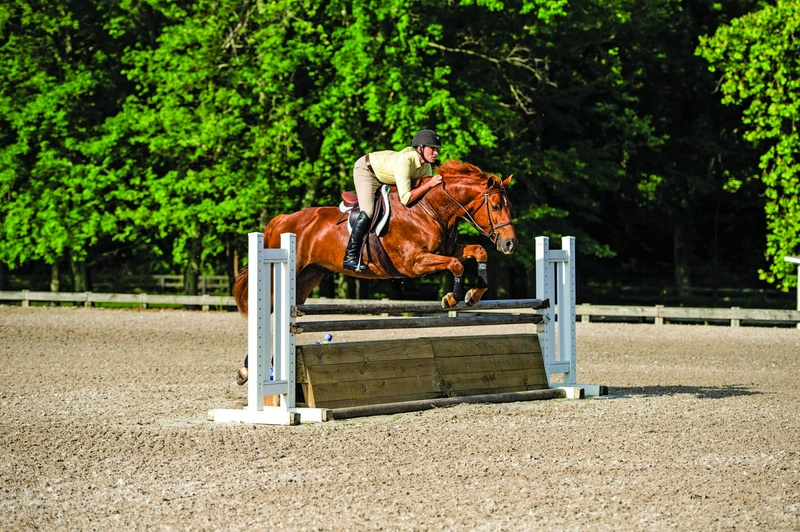
When judges want to rank in hunter classes, they ask themselves, "Which of these horses would I like to ride?"
With rounds that last only 90 to 120 seconds, there is not much time to show that your horse answers this question.
From the moment you enter the arena until you leave it, your performance must be filled with comfort and confidence.
The connection between you and your horse should be almost invisible.
Nothing should distract the judge from the horse's round.
In fact, the best riders appear so blended into the scenery that the only thing that stands out is the horse itself.
Top hunter riders allow the horse's demeanor and expression to show so that every obstacle it faces is simple, smooth, and spectacular.
When I gallop a hunter round, I try to demonstrate a beautiful and completely consistent rhythm, soft turns, and balanced takeoffs and landings so that the only thing the judge sees is Calucci, the 9-year-old gelding of Lynn Allen Rice.
How can you present a round of this quality?
By creating an outstanding first impression and showing a beautiful and completely consistent rhythm from start to finish, along with soft turns and balanced takeoffs and landings.
I will provide you with tips and exercises to work on at home to achieve these goals.
This month, I will talk about forward momentum and provide exercises to maintain it until reaching the obstacle and while turning towards a line.
Next month, I will introduce an exercise for turning around an obstacle and jumping from another obstacle across the diagonal of the arena, as well as another exercise for turning the head while jumping in between a grid, to improve your ability to look ahead.
Start as you want to finish; a winning round begins with the same initial canter and first jump.
This is neither warming up nor a free jump; it counts as well.
Approach the first obstacle with the canter as if you have already passed four obstacles before it.
This shows from the very beginning that you intend to execute this round smoothly and confidently.
In the adult amateur section, the most common note I write on my judging sheet for the first jump is "slow and close."
Riders are often hesitant and do not bring the horse forward enough.
As a result, they arrive at the first obstacle too close and/or weak.
This makes me think to myself, "Do they even want to jump this obstacle?"
If the feeling you convey is "I'm not sure I want to be here right now," you shouldn't expect a high score.
Part of this hesitation comes from stress.
For tips on dealing with it, refer to the sidebar at the bottom of the page titled "Keep Your Cool."
Part of it also relates to inexperience.
Perhaps the biggest difference between amateurs and professionals is that amateurs "wait for the time to go," while professionals "go until it's time to wait."
Professionals confidently approach the obstacles; even when they haven't yet determined the takeoff spot.
If you are coming forward and need a little extra length in your stride to reach the obstacle correctly, that option is available to you.
If you need to pause and give your horse a fraction of a second more time to settle into its stride, that is also easy to do.
However, if you are too cautious and do not send the horse towards the obstacle, you will no longer have these options available.
You may see the distance late, in the final approach to the obstacle, and want to suddenly attack it.
Your horse, caught off guard by this sudden change and losing its balance, makes a medium jump and lands unevenly on the other side of the obstacle.
The worst case is approaching the obstacle carefully and then realizing you need to slow down even more.
At this stage, even the most experienced horses struggle to do their job.
Without impulsion, straightness, and confidence, our noble companions are forced to come out of a difficult position right in front of the obstacle; a situation created by our backward riding.
The result of this situation can be an extra inappropriate step, refusal to jump, or even a fall.
Even if the jump does not completely fail, you have still created a severe change in the rhythm of movement; a major flaw in our sport, as such situations are unsafe.
Similar errors frequently occur on single obstacles with a long approach path.
For some riders, this situation is like Pandora's box.
Because they feel they have plenty of time and need to do something, they get caught up in changing everything; sometimes several times in a row; whether in search of the ideal distance or wanting to straighten their horse.
Riders competing in hunter classes from heights of 2 feet to 3 feet and 6 inches only need to reach a suitable jumping spot to give their horse a chance to jump well.
They do not require the precision of riders jumping at heights of 4 or 5 feet.
Instead, they should focus on establishing rhythm, pace, and the correct line, and then let go of distance control.
The following exercises will help you accomplish this.
For these exercises, you need a horse that has the ability to adjust and is willing to move forward calmly.
(Although these exercises are primarily designed for riders jumping at heights of 3 feet and 6 inches or less, they can easily be adapted for all levels.)
Assignment: Increase the rhythm Start the work with exercises to increase the rhythm.
Get comfortable with the concept of moving forward until you see it is time to do something else; whether this is a quiet and subtle request from the horse to wait or slightly increasing its stride length without changing its rhythm.
The method is as follows: place a flower box or a pole on the ground, on the line of a quarter or on a long approach path at an angle.
The goal is to move in a straight line from one end of the arena to the other and jump the obstacle "out of stride"; that is, maintain the same forward and rhythmic canter throughout the entire path, without making any changes.
When you enter the turn, look at the place you want to eventually reach.
Find a specific point to focus on; for example, a leaf on a branch of a tree or a knot in the wall of the covered arena.
This point should be your focal point.
The ground pole or flower box should only be part of your straight path to your destination.
You can take a brief glance at it, but your main focus should be on a point beyond the end of the arena.
Your body will follow your gaze, and so will your horse.
If you deviate from the line, do not take your eyes off the focal point.
As you look at that point, use your legs, seat, and hands to bring him back to the line.
As you exit the turn, move forward.
This not only increases your chances of jumping over the flower box at the right stride but also helps straighten your horse.
Imagine you have a piece of loose string on the table that has fallen in a spiral shape.
If I tell you to straighten it by pulling both ends, it will take a long time to straighten.
But if you pull the ends of the string apart to make it longer, it will straighten very quickly.
It’s the same for your horse.
The best way to straighten your horse is to make him taller.
Once you establish this forward counter, maintain it.
Tell yourself this approach is no different from any other approach.
I often hear students asking, "What should I do when I don’t know what to do?"
Trust that when you don’t see the distance to the ground pole or flower box—whether it’s 20 strides away or two—you have already set your rhythm, tempo, and line.
All you need to do is keep your upper body straight and let the jump come to you.
Whatever the outcome, it’s better than a sudden change at the last moment due to panic.
In this way, go over the ground pole or flower box two or three times in both directions with the counter.
Then move on to other exercises.
A little later in the same riding session or another day in the same week, return to this exercise to remind yourself of the importance of maintaining a consistent speed, line, and rhythm.
Repeating these consistent approaches gives your "eye"—that is, your ability to judge the distance to the appropriate take-off point—a chance to improve.
If you change your counter in each approach, you will never gain such an opportunity.
1.
For the exercise of moving straight and forward towards the obstacles, I place a simple flower box on the quarter line of the arena.
Along the flower box, I place a chair at the end of the arena so that my focus is on it during the approach.
2.
When I bring the Calucci to the flower box in the turn with the counter, I look beyond it towards the chair.
When the chair aligns with the center of the flower box, I ask him to move forward.
This creates confidence and rhythm in our approach.
You can see that he is completely straight.
As a result, I don’t need to make a big change in his stride right before the flower box.
Instead, just a few strides before it, I straighten my upper body and let the "jump" come towards me.
3.
As I fly over the flower box, my eyes are on the chair; the very place I want our path to end.
At this stage, my job is to let the Calucci take care of the obstacle while I stay calm and balanced in the saddle.
4.
After his landing, my eyes are still on the chair.
This helps me stay on the right path without losing rhythm or tempo.
Again, the Calucci remains completely straight and follows the cues from my balance and focus on the chair.
Smoothly navigate the turns; another important element that is often overlooked in an exceptional hunter round is the turns.
When executed correctly, they make the jumping much easier.
When executed incorrectly, they make the jump significantly more difficult.
If riders turn too early or too late, they usually end up either crashing into the obstacle, pulling back on the reins in hopes of gaining more time, or trying to steer the horse left or right to correct their late path.
All of these actions throw the horse off balance and limit its ability to execute a quality, straight, and square jump.
Maintaining the same rhythm of movement throughout the turns is challenging for many riders.
They counter to the end of the arena, lose the rhythm in the turn, and then try to find the counter again.
In a soft and beautiful hunter round, that counter must be maintained and present throughout the turn.
Another troublesome habit that ruins turns is riding with a "tunnel vision" between the horse's ears.
Riders who do this typically turn first and then look to see where they are.
It's just like changing lanes in a car: you shouldn't just turn the steering wheel and then see if you're in the right lane or not.
These mistakes are especially common when the approach line to the obstacle involves passing by another obstacle.
For example, when you need to pass around an outer line to reach a single obstacle on a diagonal line, this situation really disrupts people's vision.
Riders usually do not plan for the turn until they have passed the first obstacle.
By that time, they have lost the correct turn and are positioned on the wrong path toward the obstacle.
Then they spend the next few steps correcting that mistake and reorganizing; something that often ruins both the jump and the flow of the round, and besides that, confuses the horse as well.
The solution to such problems seems simple in theory, but it is not always easy: look before you turn.
Get in the habit of turning your head and looking at where you want to go before you start the turn, and then align the horse with that point of focus.
Remember that your body and your horse will follow your gaze.
Practice: By maintaining the rhythm of movement throughout the turn by creating a reliable system for yourself, you can build better quality turns and eliminate irregular and unstable approaches from your courses.
This next exercise, which is turning on a line, and the exercises I will share next month, will improve your turns and your ability to look ahead.
Turning on a line builds on the focal skills you learned in the previous exercise.
Place two obstacles in a line along the side of the arena; at least five strides apart (72 to 76 feet, depending on your horse and the height of the obstacle).
Counter to the end of the arena and while maintaining enough contact with the reins to prevent the horse from going faster, push your legs into the horse's sides.
This engages the back part of its body with energy and improves the quality of its counter.
It also helps maintain the rhythm throughout the turn so that when you exit the turn, you have the same counter that you had when you entered it.
As you counter across the width of the end of the arena, turn your head and look at the first obstacle of the line.
When the second obstacle comes into view between the standards of the first obstacle, begin the turn toward the line.
When the turn is complete and the two obstacles are aligned, guide the horse to the center of both obstacles and keep your gaze on a point beyond the end of the arena.
1.
As I turn with the counter around the end of the arena, I turn my head to look at the first obstacle of the line.
At the same time, I maintain my balance in the saddle and keep my connection with Calucci to ensure he maintains his good forward rhythm.
As you can see in this photo, when the base of the second obstacle begins to appear between the bases of the first obstacle, I start the turn.
2.
Then, when the two obstacles are aligned, I focus my gaze on a point beyond the end of the arena and ask Calucci to go forward to the center of the first obstacle.
You can see that his focus is also straight ahead.
3.
When he jumps from the first obstacle, I keep my gaze on that same point beyond the end of the arena.
Despite the intense heat (during a photoshoot in the middle of summer), Calucci still appears eager and interested in his work.
His path remains completely straight while flying over the first obstacle.
4.
As we approach the second obstacle along the line, I shift my weight slightly into the saddle to support Calucci at the moment of takeoff, but my focus remains on that same focal point.
I know he is in the best position for a good jump because we have maintained a very good rhythm, speed, and path from start to finish.
Repeat these two exercises enough times until you feel completely comfortable and confident in maintaining your speed up to the obstacle and also in turning towards the line of obstacles.
Next month, I will introduce two more exercises that build on these skills and help strengthen them.
Stay calm to start a round with confidence, make sure you have done the necessary preparations, arrived on time and early to learn the course, and reviewed your riding plan with your coach.
The more opportunities you have to be in the competition arena, the better you will control your anxiety.
If you cannot consistently participate in competitions, find ways to simulate competition conditions at home or at a friend's farm.
In the arena, set up a course and place a few warm-up jumps in another arena or in the adjacent paddock.
In this separate section, warm up just like on competition day, then enter the arena and ride the course as if you are in a horse riding competition and no one is guiding you along the way.
Jump the course only once and tell yourself that you must accept the result as it is.
This "no second chance" mindset will help you analyze your rounds better and be more prepared for the next time.
To perform your best on competition day, use the same strategies that schools recommend to students before exams: get enough sleep the night before, don’t leave things to the last minute, wake up early enough to have a good breakfast, and drink enough water.
Mentally, the several-hour wait to start your class in the horse riding competition can be challenging.
Many riders become so anxious that they forget to eat and drink, and this really affects their performance.
Try to eat something a few hours before your class; even if it's just a small amount of protein source, like nuts and grains.
Fuel this machine so that both your body works properly and your mind stays alert.
If you can, bring a supportive friend along to remind you how lucky you are to have the opportunity to participate and ride in the equestrian competition.
This is all meant to be enjoyable!
After finishing your work, evaluate your day as a step in a long journey, not as a final result.
Practical Horseman thanks Lynn Rice for providing the location and horse used in the photos for this article.
From IHSAA to the Tom Brennan circuit, hunter rider, trainer, and "R" judge of the United States Equestrian Federation, he began his successful professional career as a member of the Stonehill College equestrian team.
While earning his psychology degree, he won two individual championships at the national Intercollegiate Horse Show Association competitions and also led his team to the IHSAA team championship as captain in the 2002–03 season.
He then joined the training program of Tony Workman at Winter Hill Farm in Hillsboro, Virginia, where he started his career as a groom and gradually rose to his current position as assistant trainer.
Along the way, clients like Lynn Rice helped him collaborate with talented horses in the competition arena.
He earned his first indoor competition license with David and then participated in several major championships with Gramercy Park and Purple Heart.
In 2012, Gramercy Park was named Horse of the Year in the hunter division of the USHJA Hunter Championship program, and Tom also earned the WCHR National Emerging Professional Champion title.
This article was first published in the February 2017 issue of Practical Horseman.
Source: Practical Horseman – Training