Why self-carriage is important in all equestrian disciplines
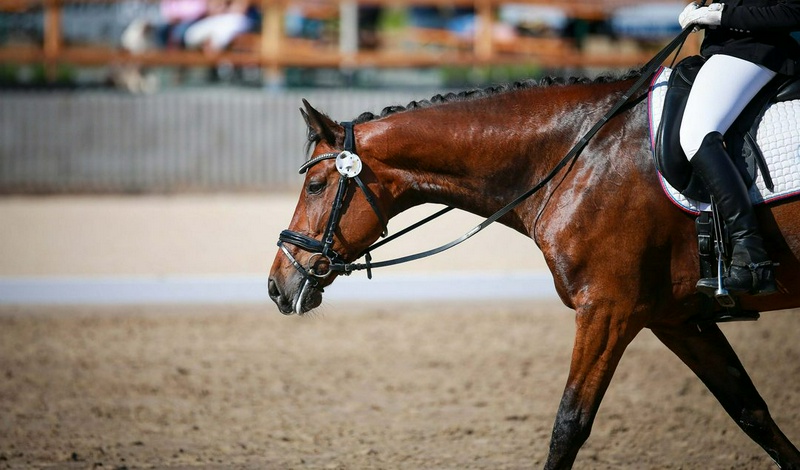
Once, I tried a well-built and powerful Anglo-Arab horse as a loan competition horse.
The owner's coach was also present to guide this test.
Overall, this mare was an amazing athlete; strong, capable, graceful, and energetic.
Of course, when she really moved.
I sat on the horse and helped with my legs; she would take a few steps and stop, or trot a little and then slow down.
The coach said, "Give her your legs!
Hold the leg!
Come on, don't be lazy; real riding is a great exercise for the thigh muscles!"
I didn't take that horse on loan.
But the reason wasn't laziness; neither on her part nor mine.
The bigger problem was that this young chestnut mare had absolutely no understanding of what scientists call "self-carriage."
And that was a determining factor for me.
As leading equestrian scientists emphasize, self-carriage is vitally important; a concept that plays a fundamental role in performance, safety, and above all, the welfare of the horse.
In this article, we take a closer look at what self-carriage is, why it matters, and how it relates to the future of equestrian sports.
What exactly is self-carriage?
Self-carriage is a concept that does not have a uniform definition in the world of horses and riding, and depending on the discipline, competition level, training method, and rider, different interpretations are offered.
This concept is often depicted as a kind of biomechanical skill that is a blend of collection and balance, and it brings to mind the idea that horses seem to "carry themselves" lightly in the air, as if suspended by an invisible harness.
Although this is an important goal in athletic performance, self-carriage is not this from the perspective of researchers who study horses' ability to learn, perform, and interact with humans.
Instead, self-carriage is a clear and pure product of good training.
Andrew McLean, Ph.D., B.Sc., and Diploma in Education, founder of the Australian Equine Behavior Center in Victoria, explains: "It means teaching the horse to do the task; and it does it on its own."
He says, simply put, a horse that has achieved self-carriage continues to do what we asked without constant reminders.
Unlike the mare I tried, these horses respond to the rider's leg aid to go into a trot and continue trotting until the rider asks for something else; for example, until they are asked to slow down, speed up, or stop.
Similarly, horses with self-carriage maintain their lateral movements — straight, diagonal, shoulder-in or shoulder-out, and turns — as well as their head and neck position on their own.
They even continue complex movements like piaffe and passage until they receive a stop signal.
Andy Booth, a science-based horse trainer operating in southwestern France, explains that essentially, a horse with self-carriage is like being on autopilot or cruise control.
McLean, to explain this concept, likens it to a trained bird sitting on someone's shoulder.
He says, "If you tell me you've trained this bird to sit there, to prove it, you really have to let go of its wings.
Otherwise, you're just keeping it there."
And according to our sources, this issue is of great importance because self-carriage is better for the mind and body of horses, as well as for their relationship with humans.
Impact on performance, safety, and welfare According to McLean, horses learn through the rewards they receive, such as the release of pressure.
This release of pressure signals to the horse's brain that it has given the "correct" response because it was the response that caused the pressure to stop.
McLean explains that if you ask a horse to move forward with leg pressure and release the pressure as soon as it moves forward, the horse understands that moving forward is the correct response.
But if you maintain the pressure while the horse is moving forward, the horse assumes it has not yet found the correct response.
And if the release of pressure coincides with the horse stopping, you have effectively told the horse that the "correct" response to leg pressure is to stop.
Booth says if this seems confusing to you, it's even more confusing for the horse.
When moving forward does not relieve leg pressure, or when slowing down or tucking the nose in does not relieve rein tension, the horse has three choices: continue trying — with more and more insistence — try something new, like bucking, or give up altogether.
Such horses are often labeled as stubborn, lazy, difficult, or hard-mouthed.
Some of them even develop a form of depression in horses.
And most of them ultimately endure much more frequent and intense pressure than they should.
In contrast, McLean says self-carriage gives the horse a sense of autonomy.
The horse can control leg and rein pressure by responding in a way that removes the nuisance.
This, along with its alignment with learning theory — the scientifically validated concept of how horses learn — has made self-carriage one of the 10 core pillars of ethical horse training as defined by the International Society for Equitation Science.
The tenth principle of this society asks riders to "consider self-carriage," meaning they should train their horses to maintain gait, tempo, stride length, direction, head and neck carriage, and body posture without force, constant fiddling, or incessant signaling.
The society emphasizes that the absence of self-carriage endangers horse welfare.
Self-carriage also improves performance and makes riding safer for both horse and rider, not just in dressage but in all disciplines, including show jumping and eventing.
Much of this advantage is because it frees the rider to focus on balance rather than constant signaling, while also freeing the horse's body to perform the task ahead.
Gemma Pearson, Director of Equine Behavior at The Horse Trust in Scotland, says: "It all comes back to self-carriage; for example, preparing the horse for an obstacle and then getting yourself into the best balance position so the horse can use its body effectively."
McLean says horses working in self-carriage perform more willingly, move more fluidly, and breathe better.
Overall, all of this leads to the image of willingness and the "happy athlete" respected by the FEI, while also helping to improve the image of equestrian sports in general.
McLean says: "The principle of self-carriage means accepting that we must avoid forcing and holding the horse, as well as continuous harassment with the leg and rein."
He added: "If we do this, we will no longer see overly tight nosebands, hyperflexion, or blue tongues.
This is the answer for the future."
Self-carriage is not limited to dressage.
© Adobe Stock/Wiprotastchik The Way Forward: Self-Carriage in Equestrian Sports According to McLean, self-carriage is so vital for ethical training and equestrian sports that it should be assessed even in the competition arena.
He says: "This should be one of the very important elements of judging.
We must show in every movement and in most movements that we can release the rein for a few steps.
If the horse falls out of balance and framework, it means it has not been trained for self-carriage."
Roly Owers, veterinarian and CEO of World Horse Welfare, also agrees with this view.
He welcomes the efforts recently announced by the FEI to include self-carriage as an official element in the judging criteria of high-level dressage tests.
At the FEI Sports Forum in 2026, held in March in Lausanne, Switzerland, Ronan Murphy, FEI Dressage Director, told attendees that the organization is considering adding a section titled "Free Movement" in the Grand Prix dressage; a section where riders release the rein more in trot.
According to Murphy, this section helps determine whether the horse "stretches the neck," "chews the bit," and "responds when the rider gathers the rein again."
Murphy explained: "We are not asking them to have no contact with the bit at all.
Contact is still maintained, but on a longer rein.
And our emphasis is that the horse must maintain its rhythm, balance, and cadence.
The horse must remain supple and light in the shoulder despite the longer rein, and the hind legs must be well engaged.
Therefore, this is not a free step."
Owers says this is "obviously a positive point."
However, at this stage, it is still unclear what exact effect this section will have on the judging score; it may just be a form of window dressing for spectators without actually affecting the rider's score.
He says: "It will not necessarily have the effect we want."
He also questions the shortness of this section.
Owers asks: "Why not have two or three of these throughout the test?
This is probably not enough."
He adds that the requirements regarding rein contact also create another puzzle.
While current dressage rules encourage continuous contact with the bit, "this is completely contrary to the logic of pressure release and the way horses learn."
He says he would like this issue to be examined in the current discussions about updating the judging guidelines.
He says: "The FEI is taking a step in the right direction.
But self-carriage should become a much more central element in the evaluation and scoring of dressage."
Murphy also agrees that the performance of horses in the dressage arena should reflect proper training and horse welfare.
This includes demonstrating their self-carriage; an issue that he emphasizes judges have been evaluating for years.
Murphy says: "This is extremely important."
Source: Practical Horseman – Training