Paul Blazík about working with lateral movements
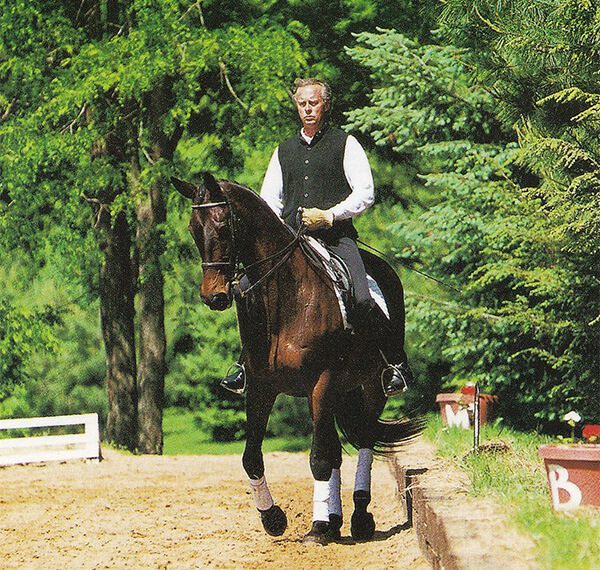
The Importance of Lateral Movements in Riding: Why Is This Important?
by Paul Blazik Recently, one of the riders preparing to compete asked me how he should execute lateral movements.
He was confused by the rules, because some movements are to be done on three tracks and others on four tracks.
And over the years, this has changed.
This person did not know what long-running debate this simple question had sparked.
Shoulder-in on Three Tracks In this shoulder-in to the right on three tracks, the inside hind leg passes in front of the outside hind leg and steps under the horse’s center of gravity (photo – Karl Leck) Personally, I can go back about forty years, to when my old trainer H.
L.
M.
van Schaik wrote his book "Misconceptions and Simple Facts in Dressage" (J.
A.
Allen).
He devoted an entire chapter to the shoulder-in and discussed whether shoulder-in on three tracks or four tracks is correct or classical.
I’m sure many of his students still remember him lecturing about this.
He was not the only one to address this issue.
I think for this article it is better to generally set aside the debate about tracks and focus only on some of the mechanics of lateral movements that may help a rider decide how to execute and practice lateral movements.
The historical evolution of shoulder-in is very interesting.
La Guérinière, who is credited as the inventor of shoulder-in, gives this credit to his predecessors, the Duke of Newcastle.
Newcastle, in an effort to free the shoulders for training and to improve the horses’ airs above the ground (a complete shift of weight to the rear and a complete lightening of the horse’s forehand), moved the horse essentially around a pillar and thought that this crossing of the legs (especially the forelegs) would give the horse more freedom in front.
La Guérinière realized that if he used the same idea of lateral movement, but moved the horse along a wall, he could prevent the hindquarters from escaping or drifting away and actually engage them.
The result was a lighter and more supple forehand through a transfer of weight from the front of the body toward the rear.
In this particular case we are talking about shoulder-in, but in general lateral exercises can help the horse learn collection.
The lesson here is that increasing lateral movement does not necessarily mean improving collection or reducing pressure on the forehand.
Four Track Shoulder In This four-track lateral movement of the legs evolved.
By blocking the escaping movement of the haunches, it can increase collection.
(photo – Karl Leck) One of the factors that adds to the confusion in lateral work is that these exercises can have different uses, which determine how they are performed.
One of their main uses is to help introduce and improve collection; that is, the horse’s ability to shift balance toward the more powerful haunches, which can reduce the natural pressure on the forehand.
Wild or untrained horses carry about 58% of their weight on the forehand.
In all lateral exercises, one hind leg crosses over the other and steps under the horse’s mass, so that leg bears more weight.
Repeating these exercises improves flexibility and strength.
These exercises are especially useful because they can introduce the idea of carrying more weight on the hindquarters (or collection) one leg at a time, unlike an exercise such as piaffe, in which both hind legs must come under the body and require more strength and balance.
If one hind leg is less skilled or weaker than the other, you can work more on one side to make the movement more symmetrical.
Three Track Travers In this movement too, the hind leg passes in front of the opposite hind leg and comes under the center of gravity, placing more load on that leg.
(photo – Rose Caslar Belasik) Four Track Travers Although more bend may have value, the rider should always be aware of the inverse relationship between lateral movement and load.
At the beginning of the article I said that one of the factors adding to the confusion in lateral exercises is that these exercises can have different applications.
Probably all mammals are to some degree laterally dominant.
For a person, usually one hand is right- or left-dominant, and in rare cases a person can perform tasks equally well with both hands and both sides of the body.
Horses are also trained in the same way.
Some bend easily in one direction and are stiff or resistant in the other.
I have spoken in the past about the possible reasons for this, but for the sake of this article we will pass over them.
A few days ago I heard that a trainer recommended not using the "haunches in" exercise (travers), because it can easily cause horses to become crooked and he does not want to teach an exercise that may encourage this evasion.
Now we are faced with another biomechanical dilemma in lateral work, and that is that you cannot straighten the horse by riding straight.
Because of lateral dominance, you must use the green-stick method.
If a green stick is bent to the right, you bend it to the left, and when you release it, it straightens.
If your young horse is constantly carrying its haunches to the left, you can use lateral exercises in the opposite bend to correct crookedness and balance asymmetry.
So in these cases, we use lateral exercises as a correction for natural asymmetry or crookedness in horses.
I know my collection may suffer a bit, but I may need to bend a little more to the difficult side.
This is important because if I cannot straighten the horse, I will never be able to achieve correct collection.
It is like driving a horse team in which one is always slack in the traces and the other is always overworking.
The point is that lateral exercises can have different applications, but the rider/trainer must know when and whether load or bend is being compromised, and why.
Riders must be able to recognize and feel the differences between three-track, four-track, or complete separation of the hind legs.
If you stop the trainer and ask: "What are you doing and why?
" they should be able to explain clearly and understandably what they are doing.
Lateral exercises are not about riding by a fixed instruction or rulebook.
They are about using exercises to counter crookedness and increase engagement to reduce pressure on the forehand.
Developing collection and better longitudinal balance creates a more balanced and symmetrical performance and will result in a healthier horse.
Three Track Renvers Renvers is the counterpart of travers.
The right hind leg steps in front of the left and moves under the center of mass.
Lateral work is mainly affected by this biomechanical dilemma: the inverse relationship between lateral movement and load.
The more the horse is asked to move sideways, the less it can carry weight or collect.
For this reason, many dressage masters have warned about leg-yielding, which can easily cause the hind legs to separate and have the opposite effect on collection.
Therefore, there is an ideal amount of lateral movement of the hind legs that should be observed when trying to develop collection.
Too much lateral movement actually causes the horse’s hindquarters to separate.
If the separation of the hindquarters is too great, how can the horse remain standing?
The answer lies in the forehand.
The forehand carries more weight, which is contrary to the purpose of the exercise.
Conversely, if there is not enough lateral movement, the exercise will not be of much value.
Four Track Renvers when you ask the horse to bend more or move more, you may unintentionally put the horse more onto the forehand because the hindquarters cannot carry more weight if they move too far sideways.
I have joked that riders should take an introductory physics course, because what I see and hear these days from famous riders and even judges, or the explanations in online dressage lessons, is nonsense and often contradictory.
What is wrong with dressage riders’ training that they do not clearly understand simple scientific concepts?
We need lateral exercises to introduce collection, which is the art of controlling the horse’s longitudinal balance.
We also need lateral exercises to overcome natural asymmetry or crookedness, which is the art of controlling lateral balance.
In this way, we help the horse become softer and more supple, and keep our equine partner healthy for longer.
Source: The Horse Magazine