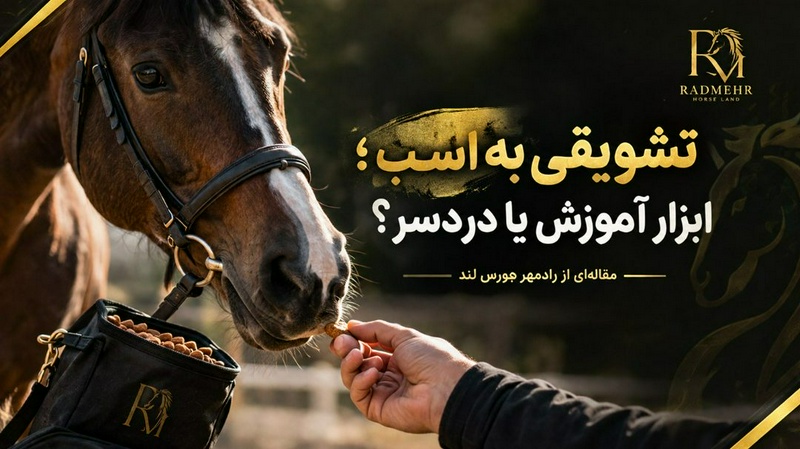
Encouragement for the horse; a training tool or a hassle?
1.
What exactly does giving a treat to a horse mean?
A treat can be part of a training method based on Positive Reinforcement.
In positive reinforcement, after the horse performs a desired behavior, a pleasant consequence is created for it; this consequence can be an appropriate treat.
The goal is for the horse to learn the connection between the correct behavior and the desired outcome, increasing the likelihood of repeating that behavior.
Therefore, a treat is not simply "feeding the horse."
The important difference is here: feeding: a treat without a specific connection to a behavior.
Educational treat: providing a reward related to the behavior we want to reinforce.
This simple difference turns a treat from an ordinary snack into an educational tool.
2.
Why do we use treats?
Proper use of treats can help in several areas of horse training.
Increasing motivation: a reward can make the horse more eager to participate in an exercise or learn a new behavior.
Faster learning: when the consequence of a behavior is pleasant for the horse, the connection between behavior and outcome can become clearer for it.
Creating a positive experience: in some training situations, creating a positive experience can help the horse experience the situation with a more favorable feeling.
Enhancing cooperation: when the horse realizes its desired behavior is accompanied by a suitable result, cooperation between the horse and human can be strengthened.
Reducing fear and stress: in some situations, a treat alone is not a cure for fear or stress; however, in a proper training program, it can be used to create a positive association with some unfamiliar or difficult situations.
Training new behaviors: treats can be used to reinforce specific and observable behaviors; provided that the timing and method of delivery are correct.
3.
When should we give a treat to the horse?
One of the most important principles of using treats is timing.
If the horse has performed a desired behavior but the treat is given several seconds or even longer afterward, the horse may not realize exactly which behavior it was rewarded for.
For this reason, it is better for the connection between behavior and reward to be as clear and quick as possible: desired behavior → confirmation signal → treat. In professional training, a specific signal like a sound (well done) or a verbal cue may be used to show the horse exactly which behavior was approved.
For example, if the goal is for the horse to stand still and calm for a few moments, the treat should be given in connection with that desired behavior; not when the horse starts pushing, searching for treats, or engaging in inappropriate behavior.
The right timing for a treat is part of the training itself.
4.
What should we give to the horse?
The choice of treat should be compatible with the horse's health, physical condition, and nutritional needs.
Common options include treats like carrots and apples, as well as some commercial horse-specific treats.
But there is a very important point: not every treat is suitable for every horse!
The horse's physical condition, the sugar and starch content of the treat, metabolic conditions, and history of health issues can be important in choosing a treat.
For example, in horses with dietary restrictions or metabolic problems, the choice of treat should be made with greater care.
The food should also be offered in small, manageable pieces to both manage consumption levels and reduce the risk of improper swallowing.
Details of permissible and prohibited foods, as well as the appropriate amount of treats for each horse, is a specialized topic that will be examined separately in future articles by Radmehr.
5.
Common Mistakes; The Line Between Reward and Creating Undesirable Behavior One of the most important points in using treats is that not every behavior should be rewarded with food.
Some common mistakes include: Giving treats for undesirable behaviors If a horse pushes for food, searches a person's pocket, or shows inappropriate behavior and receives a treat at that moment, the same behavior may unintentionally be reinforced.
Not waiting for the correct behavior The reward should be associated with the target behavior, not merely with the presence of the horse or its request for food.
Using large pieces Very large pieces not only make it difficult to control the amount of food but can also increase the risk of improper swallowing or choking.
Overuse of treats should not become a significant part of the horse's diet.
Allowing the horse to take food from a pocket or hand This behavior may gradually become an undesirable habit and, in some horses, reinforce pushing, searching, or even biting behaviors.
Therefore, the goal of treats should be training, not merely satisfying the horse.
6.
The Golden Rule of Giving Treats to Horses If we were to summarize this entire article into one principle, it would be: Treats should be accompanied by desirable behavior, correct timing, and attention to the horse's health.
A good treat should have four main characteristics: Proper training We should know exactly what behavior we want to reinforce.
Precise timing Offer the reward close to the desired behavior.
Attention to the health of the food and its quantity should be compatible with the horse's condition.
Mutual respect Treats should not cause aggressive behavior, pushing, or disrespect in horse-human interactions.
Simply put, treats are not a substitute for training; they are part of proper training.
7.
A Treat is Not Just Food If used correctly, a treat can be a tool for motivation, reinforcing desirable behavior, and creating a positive experience for the horse.
However, the difference between a useful treat and a simple piece of food lies in how it is used.
A treat becomes valuable when we know: what to give, when to give, and most importantly, for what behavior to give.
This is just the starting point.
In future articles by Radmehr, we will delve into more details about the correct method of giving treats, clicker training, training young horses, using treats in loading horse trailers, hoof care and veterinary care, training during riding, competition horses, overweight horses and those with laminitis or EMS, permissible and prohibited foods, and the amount of treats based on the horse's weight.
Sources British Equine Veterinary Association (BEVA) Deanna Corby Dressage Veterinary Equine Behavior Sources