Gymnastics training for improving hunter rounds
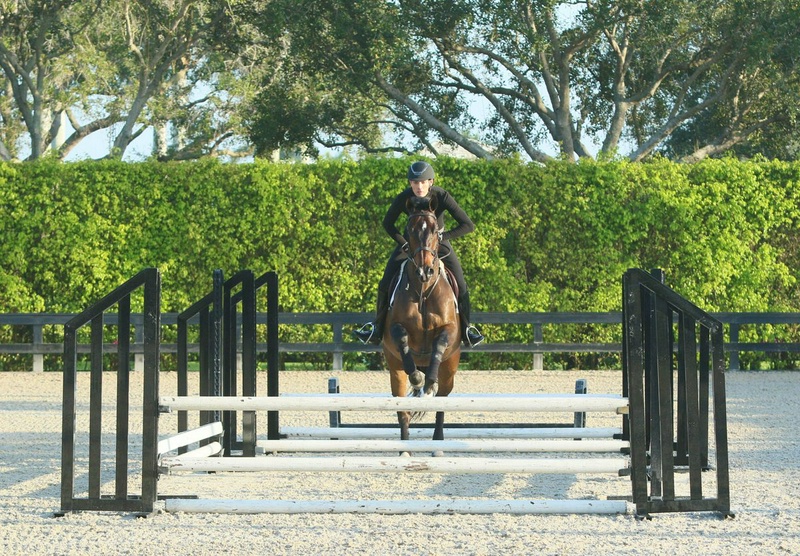
While you might think that gymnastic exercises are mainly used to keep horses sharp and ready in the show jumping arena, Geoffrey Hesslink, a prominent hunter rider and trainer in the United States, regularly uses this gymnastic and cavaletti exercise to improve the movement and physical fitness of his hunter horses, helping them learn how to judge distances and have better form over obstacles.
Geoffrey Hesslink, a prominent hunter rider and trainer, incorporates gymnastic exercises into the training program of all his horses because these exercises offer significant benefits for both inexperienced and more experienced horses.
Additionally, they can help riders at all levels perform better in the hunter ring.
Hesslink demonstrates in this training how to ride this gymnastic and cavaletti exercise to improve hunter rounds and the rider's body position over obstacles, explaining how this exercise can be beneficial for both young horses and more experienced ones.
How to set up the exercise: Gymnastics: Place a ground pole 9 feet away from a small vertical obstacle, then another 9 feet to the second vertical obstacle, and then 18 feet to a vertical obstacle that is slightly taller.
You should enter the ground pole at a trot and then continue at a canter through the cavaletti section to the final vertical obstacle.
Cavaletti: In the middle section of the gymnastics, set up four cavaletti that are slightly elevated off the ground in a four-cavaletti set; the distance between all of them should be 9 feet.
This exercise should be done at a canter.
(For a full overhead view of how to set up this exercise, see the "Progress at Every Level" section below.)
Executing gymnastics by entering at a trot, he said: "When you first introduce gymnastic exercises into your horse's program, it's important not to rush and not to make him nervous.
In the early stages of learning gymnastics, most horses try to guess the next move or rush through it.
So stay calm and just let your horse work through the exercise to understand it himself.
"This exercise is designed to teach horses to build their own form, evaluate their own jumps, and ultimately learn the appropriate rhythm needed for this exercise.
"Throughout this exercise, my effort is to work on the straightness of the movement while encouraging my horse to use the power from his hindquarters; therefore, this exercise is also beneficial for physical conditioning.
My job in this exercise is to maintain my body position correctly and not interfere with my horse so that he can perform the best jumps possible.
Especially, your hands should be quiet to stay out of his mouth and allow him some freedom in his neck and back.
"Keep the leg pressure at a level where the horse understands he needs to move forward during the exercise, but do not apply excessive pressure and do not spur him in any way, as you should not let him increase his rhythm during the exercise.
"Combining gymnastics with fences: "Once you have gone over the gymnastics a few times and your horse has learned to judge distances while staying straight and maintaining a steady rhythm, it’s time to introduce the fences into the exercise.
It doesn't matter which lead you start with.
If your horse has a favorite lead and is more comfortable with it the first time, that’s perfectly fine.
You can either continue in the direction you land on, or challenge your horse to land on its harder lead.
“Here I move to the left, so I take the left lead through the jumps.
Again, my focus is to keep my horse as straight as possible, my body position correct and balanced, and to try not to interfere with my horse's work, just letting it flow through the jumps.
“Gymnastics and jumps are really beneficial for young horses.
For example, inexperienced horses still don’t know how to create the proper body form over a jump.
This exercise forces them to really use their hindquarters, which helps them learn how to build that form.
“Additionally, some inexperienced horses are still not focused or mature enough — or are too scared — to jump full courses or lines.
So this exercise is the best option to keep them focused, use their bodies correctly, and ultimately learn to flow through it with a deep, calm breath.
” Landing on both leads “I’ve set this exercise up so you can ride it in the shape of a figure eight, allowing you to change direction frequently depending on which lead your horse usually lands on or which side it needs more practice on.
So the idea is to connect these two exercises to prepare your horse evenly on both sides of its body.
“My horse, Stuie, prefers the left lead, so I practice landing on the right lead to get him used to a more balanced use of both sides of his body; something that also helps in course work when your horse needs to land on a lead it is less comfortable with.
” Progress at any level “This exercise is also fantastic for older or more experienced hunter horses.
Since they need to push off equally from each hind leg, this exercise is excellent for physical preparation and maintaining muscle development in the hindquarters.
“Horses learn through mistakes during this exercise.
This exercise teaches them to develop their own jumping style — what works best and what doesn’t — and then gradually they retain what they’ve learned and apply it themselves.
“And most importantly, this exercise can help riders at any level of the sport; whether you are an amateur, a newcomer to competitions, or competing at the highest levels, because its effect is seen directly in course work.
I often use it for preparation before courses or specific events, as it acts like a final tune-up to sharpen the horses’ form over jumps and improve their focus.
” About Jeffrey Hesslink Jeffrey Hesslink and “Stuie”.
Jeffrey Hesslink, along with his partner Brendan Williams, is the owner and operator of Hesslink Williams Farm in Wellington, Florida.
He is considered one of the top hunter riders in the country and is one of the leading trainers for the hunter, show jumping, and equitation divisions for junior and amateur levels.
Among his latest achievements, he was selected as the top hunter rider at the Pennsylvania National Horse Show in 2023, won the $100,000 WCHR Central Hunter Spectacular at Traverse City Spring 2023, and secured second place in the International Hunter Derby USHJA in 2023, both with Dramerol.
He also triumphed in 2022 with Montrezor in the prestigious $100,000 USHJA/WCHR Peter Wetherill Palm Beach Hunter Spectacular.
See how Heslink enhances confidence in both his students and his horses by creating a positive atmosphere in training.
Source: Practical Horseman – Training