Jumping practice with horses to strengthen stride recognition in related distances
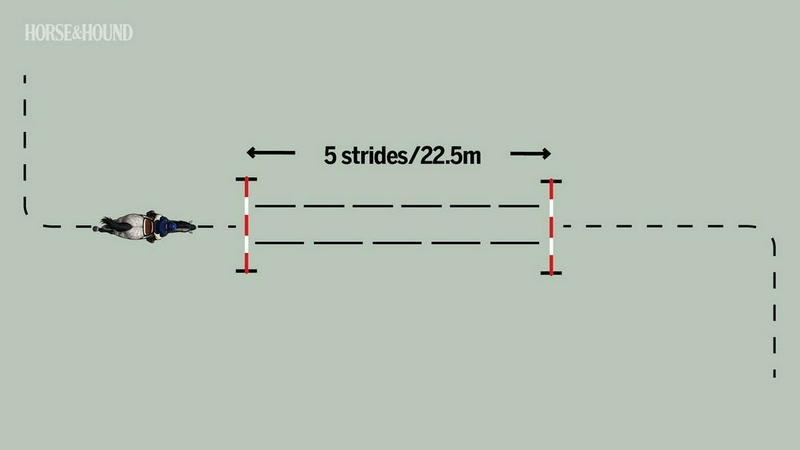
Course designers like to create related distances where the horse and rider are forced to make decisions.
A common example is two obstacles that can be jumped with either a forward five strides or a collected six strides.
The key point is the ability to adjust the stride.
The rider must be able to choose the horse's stride type when approaching an obstacle; this gives them more options.
This ability also helps you react quickly.
If your horse makes a big jump over the first obstacle, it affects your stride count to the second obstacle and vice versa.
This horse jumping exercise also helps you see the "stride" better, as you evaluate the horse's stride length when approaching each obstacle.
And remember, it's not just about pushing with your legs or pulling the reins; it's not merely about going slow or fast.
Maintaining a quality canter gives your horse the best possible chance to clear the obstacle well.
Goals of stride adjustability Impulsion engagement of limbs enhancing the eye for stride recognition Set up the exercise Place two obstacles in a straight line approximately 22.5 meters apart.
This distance may vary slightly depending on the ground and whether the exercise is indoors or outdoors, but the goal is to cover this distance with six balanced and collected strides.
To start, the height of the obstacles should be comfortable and appropriate; you can even use ground poles or cavaletti.
During the exercise, the height can be increased as needed.
How to perform this exercise First, establish a good rhythm in a well-formed, balanced, and collected canter and approach the line.
The goal is to fit six strides between the two obstacles.
For six strides, think about balance along with impulsion and maintain enough leg to ensure the horse doesn't lose strength and energy.
Repeat this until six strides become confident and comfortable for you.
Then, ride the same line with a more open and forward canter.
The goal is for the horse to lengthen its stride without losing balance; therefore, do not rush it.
Once both stride patterns are established, deliberately switch between them.
This helps you choose and produce the required canter while teaching you and your horse that the same space can be covered with different stride patterns.
Tips and troubleshooting 1.
Long and flat in five strides This means you've increased speed instead of stride length.
Ride confidently and think "upward," meaning open the stride while maintaining impulsion.
Don't throw your body forward and just follow the horse's movement with your hands.
2.
Loss of impulsion in six strides means you've slowed the canter too much, not collected it.
You still need a lot of activity and energy in the hind legs to jump the obstacle.
To keep your horse under control while encouraging forward movement, use your seat and core muscles and keep your leg on the horse.
3.
Raise the level of the exercise Make the second obstacle an oxer.
This will show you whether your horse can maintain the same adjustable canter when the jumping effort becomes more challenging.
Resist the temptation to open up too much at Chaharnal over five strides to clear a wide obstacle; but over six strides, ensure the canter is fully active and energetic so the horse can jump the oxer with a shorter stride.
If you place the oxer as the first obstacle, it affects the five or six stride distance, as the width of the obstacle reduces the space between the two obstacles.
If the distance is too tight, you may need to move the second obstacle slightly forward, but this can be a good exercise for jumping from a deeper point.
Want more ideas?
See our full collection of daily training inspirations Source: Horse & Hound