Review of Paul Belasik's new book on the "Long and Low" method in modern dressage
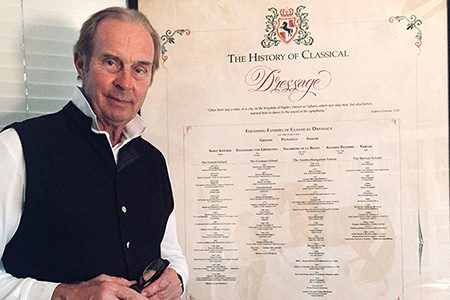
Once again, I have had the honor of reviewing a new book by Paul Belasik, Long and Low, A Revolution in Modern Dressage (CRC Press). Paul Belasik is one of the jewels of the equestrian world, but unfortunately he is one of the few remaining examples of an endangered species, namely serious dressage commentators.
In a series of books, Paul has presented his in-depth research into the writings of the great horsemen together with his fresh perspectives, which include Eastern philosophy and martial arts.
In this new work, he addresses one of the hot issues of the day, long and low, which he considers the staunch enemy of the true aim of the art of horsemanship, namely collection.
Paul lays the blame on the German military men: at the time of writing his book "Classical Dressage Training in Practice According to the H.
Dv.
12", Gert Schwabl von Gordon, by his own account, was the last living representative of the German Hanover Cavalry School.
He felt it his duty, he said, "to make clear the principles of the classical art of horsemanship as they were understood and cultivated in the world-famous school" (9).
However, as we shall see, they had redefined "classical".
Schwabl von Gordon gives us a unique account of the birthplace of long and low.
He explains that the north star of training at the Hanover Cavalry School was the H.
Dv.
12.
The H.
Dv.
12 was the German cavalry handbook for training horse and rider; Army Regulations 12.
These regulations are brief in their instructions.
There is not much information or explanation about long and low or how to achieve it, and what there is can seem contradictory.
In the manual, under section C.
Training Horses, XI.
Dressage Horses in the First and Second Year, it discusses relaxation (losgelassenheit).
It says: "The horse must learn to regain the same state it has found without a rider and to move just as unrestrained - with a high neck and nose down - under the rider's weight.
If it can maintain this unrestrained movement, it is 'relaxed' (98)."
Finally, in bold letters, it states, "Relaxation [losgelassenheit] of the horse is the basic prerequisite for the success of the entire dressage" (98).
Paul disagrees with this - it is interesting how this revolutionary idea, that the horse's natural posture in movement is "with a high neck and nose down," has been indirectly presented to all German cavalry riders.
This is an order issued by the regulations and must be obeyed, that this posture is the prerequisite for complete success in dressage.
What did this long and low look like, and what was it supposed to do?
According to Schwabl von Gordon, "Here is a summary of the essential features of long and low horsemanship.
Here two equally important criteria must be mentioned: the stretching of the horse's neck and lowering it while the horse's nose is in a vertical position.
The horse must not move freely on the bit - meaning that the rider must not allow the horse to become a fifth leg.
Instead, there must be a light but steady contact between the rider's hands and the horse's mouth.
Identifying the shoulder point as a fixed reference point for lowering the neck is wrong, because only through true stretching downward, as if the horse were following something or looking for truffles, can the rider ensure that the horse, back, and latissimus dorsi muscle are also stretched.
He goes on to say that engaging the horse’s hindquarters is not the goal, but rather suppleness.
This suppleness somehow creates the “necessary condition for engaging the horse’s hindquarters within the working frame.”
No explanation is given for how this evolved into collection.
As usual when I read one of Paul’s books, I do not agree with all of his writings.
Early on, when I started learning dressage riding, I was fortunate to train with Oswald Johnen, a graduate of the German system in Warendorf.
Oswald clearly stated that starting with a longer rein and an outstretched neck is for creating “propulsive power,” and that as we worked through the elements of the training scale, our aim, through exercises such as shoulder-in, transitions, half-pass, voltes, and so on, was decisively to develop “carrying power” – collection.
Harry Boldt, one of the greats of German dressage – collected?
Back to Paul and von Schwabl: but, to be fair, there is a passing reference to this, that all of this should be done with a light rein.
There is also the instruction that the horse should “immediately respond to the request of the outside regulating rein, bring the horse into a high and stretched-out position!
” (Schwabl von Gordon 18).
It does not take much imagination to see how the scene Baron Biel describes of riders in German schools with horses “overbent, their heads unnaturally pulled down” could have developed through this system’s teaching of the horse’s immediate obedience to lowering its head.
(Podhajsky, 20).
One of Paul’s great strengths is his tendency to look at history as the key to understanding present-day issues.
If long and low was clearly at odds with classical theory and system, where did this revolutionary new dressage training derive its power?
The rise of long and low in the late 1800s coincided with the dissolution of the world’s cavalry forces and the birth of competitive dressage.
With the advance of mechanized warfare, cavalry became obsolete.
Facing the threat of losing their jobs, many military riders turned to expanding riding to the general public.
Forward-looking riders such as the controversial German, Gustav Rau, advocated repurposing cavalry and farm horses to breed modern sport horses.
(Within a relatively short time, two world wars devastated Germany.
They had little to rejoice in except their horses.
) After several bitter defeats for German riders in 1928, Rau established a special dressage stable at the Hanover Cavalry School.
Rau appointed Otto Lörke to manage this program.
Lörke fit into this mold.
He learned the German system while serving in the First Uhlan Regiment of the Prussian Royal Guard.
Lörke was by all accounts not a flashy rider, but he did well in the new sport of dressage.
He began developing in Hanover a machine that produced competition horses and riders who could win.
Otto Lörke and Fanal made it clear that the marketers of the nascent dressage industry were aware of the appearance of German officers driving German horses in a sport of precise riding.
It was not long before Lörke introduced a team of young female riders, two trained by him and a third by his student Willi Schultheis.
In 1956, Liselott Lisenhoff, Anneliese Kuppers, and Hannelore Wiegand brought home the Olympic silver medal from Stockholm.
The warmblood horse was now a horse for everyone, for every class.
However, the German horse also came with an official owner's manual.
This Steinbrecht manual, with its emphasis on classical dressage elements, was not a continuation of the German military style.
Even at the highest levels, the emphasis seemed to be on the front end of the horses.
Many of the photos and even the training videos of Schultheis show horses exaggerated in front and struggling with the hind end.
The rider was sitting heavily rather than balancing on the seat bones.
Once again, I disagree with my friend; the photo of Linsehoff on Piaffe seems to me almost flawless.
He said: “These principles of the art of classical riding were applied at the Hanover Cavalry School and were so successful that riders from the German Cavalry School won all six equestrian gold medals at the 1936 Berlin Olympic Games in the individual and team competitions” (Schwabl von Gordon, 12).
In fact, these principles alone were not responsible for the results.
Schwabl and the German army had one narrative, but there was another from Podhajsky, who was also a medallist at those Olympics.
The German gold medallist, Kronos in My Dancing White Horses, writes: “.
.
.
After a long wait, the result of the main dressage event was announced: ‘Kronos (Germany) first, 15 points; Absinth (Germany), second, 18; Nero (Austria), third, 19; Theresa (Sweden), fourth, 26’ and so on.
I also noticed that around me many people were nodding, too, and this result was being discussed everywhere, including in the newspapers.
The German judge was responsible for pushing me down to third place, because not only did he place his three compatriots first, second, and third, but he placed me only seventh, unlike the other four judges who had placed me among the top four.
Podhajsky and Nero once again; I disagree with both Podhajsky and Paul.
Rau published a book about those Games that included many photographs (there was no ClipMyHorse at the time), but looking at the German gold medallists, H. Pollay and his horse Kronos, and one of the photos of Podhajsky and Nero, I feel that perhaps the judges made the right decision.
Paul also points out a fact (along with a number of others that I will not address in this short review) that the judges’ tastes shifted toward emphasizing Warmblood talent, and I agree with this.
When I first started reporting on international dressage, every team show featured Lippizaners with tall riders and impressive moustaches, but gradually they, like Andalusians, disappeared as emphasis on the extended trot became the main focus point.
Charlotte Dujardin – short and high?
Today the challenge is the very ugly phenomenon called short and high.
This practice seems to have begun in the Netherlands, but it has even spread to riders previously considered correct such as the two British stars Hester and Dujardin.
Perhaps we need another text from Paul that explains how this happened.
Meanwhile, we thank Paul Belasik for making us think and casting light on what dressage art should be.
Paul’s book is available in Australia and New Zealand through Booktopia, and elsewhere through Routledge and Amazon.
Source: The Horse Magazine