The effect of right-handedness and left-handedness on the rider's seat in the saddle
Most riders have a "good side" and a "difficult side," but could some of these tendencies be related to whether we are right-handed or left-handed?
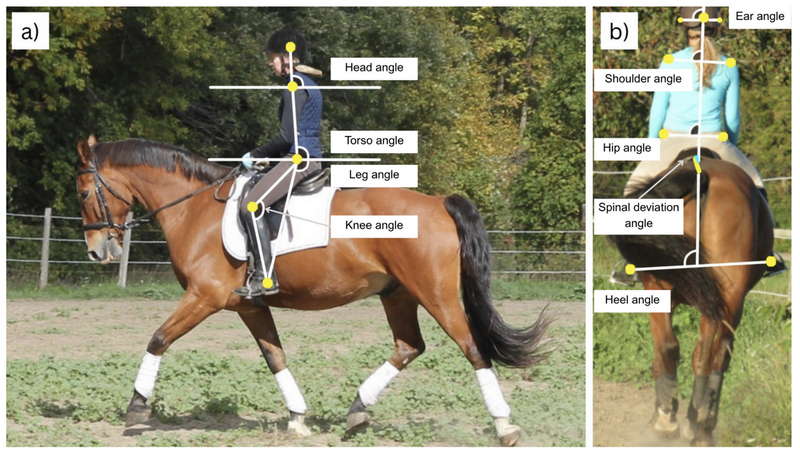
Alessia Massini, a master's student at the University of Guelph in Ontario, Canada, has collaborated on a study that examines whether a rider's lateral dominance — including dominant hand, dominant foot, and leg length — is associated with differences in their sitting position while riding.
Researchers found several consistent differences in body posture among riders who have a dominant left or right side; a finding that suggests our body asymmetries can affect how we sit in the saddle and ultimately influence how the horse uses its muscles to compensate for this lateral dominance.
Massini says, "I believe this research is important because, as far as we know, it is the first study that directly examines how a rider's lateral dominance affects their position in the saddle."
Previous research has mostly focused on how being right-handed or left-handed affects rein tension or how experience and athletic ability shape body posture, but it was still unclear what specifically drives asymmetry in a rider's position.
Left-handed riders showed a more symmetrical posture; one of the clearest findings was that left-handed riders, overall, rode in positions that were closer to symmetry compared to right-handed riders.
This study showed that right-handed riders tended to lean their upper body forward more when viewed from the left side.
Also, when viewed from behind, they had a greater tendency to bring their right foot forward and tilt their head to the right.
In comparison, left-handed riders showed fewer differences from one side to the other.
However, they were not completely symmetrical either.
Left-handed riders typically rode with their left heel lower than their right foot; a matter that raises the hypothesis that this might be because the left foot was positioned slightly higher or the heel was pressed down more.
Researchers noted that previous studies have shown that left-handed individuals often have greater functional symmetry between the two sides of their body.
Although this study did not directly measure overall body lateral dominance, the results related to riding posture were consistent with this view.
Hand and foot dominance usually aligned; this study also showed a strong connection between dominant hand and dominant foot.
Riders who were right-handed typically had a right dominant foot, while left-handed riders usually had a left dominant foot.
Riders with a right dominant foot tended to lean their upper body forward more, and from the rear view, their shoulders were positioned more to the left.
They also rode with their left foot positioned further forward.
In contrast, riders with a left dominant foot maintained a more upright upper body, kept their legs more underneath their body, and rode with a lower left heel.
Massini says, "What caught our attention was that the rider's body position changed depending on whether they were viewed from the right side or the left side."
For example, right-handed riders tended to lean forward more when viewed from the left; a topic that indicates there may be some torso rotation to the right, or even a condition that many riders refer to as "hip drop."
This issue raises new questions about how lateralization affects weight distribution in the saddle and stirrups and highlights the value of future three-dimensional analyses regarding rider asymmetry.
The length of the legs also affected body positioning; riders with longer legs tended to tilt their heads slightly to the left while standing, walking, and trotting.
Longer legs were also associated with tilting the hips to the left in several types of movements, while in the canter, the shoulders tended to tilt more to the right.
These findings suggest that some body tendencies are influenced by the natural anatomy of the rider.
What is the significance of this matter?
The practical value of this research is that it can help riders and trainers recognize predictable patterns in body posture.
For example, a right-handed rider who consistently leans forward from the torso, keeps the right leg ahead of the left leg, or tilts the head slightly to the right, is not necessarily just forming a random habit in riding.
These tendencies may be related to the natural dominance of one side of the body.
Similarly, left-handed riders may also want to investigate whether they consistently lower the left heel more than the right heel.
This study does not indicate that left-handed riders are inherently better riders.
In fact, riders from both groups showed measurable asymmetries.
However, the results suggest that right-handedness or left-handedness, as well as foot dominance, are factors that should be considered when assessing rider positioning and developing individualized training strategies.
The effort for symmetry says: "These findings could have significant implications for the horse, including potential effects on musculoskeletal health and the relationship between horse and rider."
These results also highlight the importance of individualized training for riders; including off-saddle exercises that can help improve symmetry.
This study showed that rider lateralization affects riding posture.
Right-handed riders and those whose dominant foot was the right foot tended to adopt forward-leaning positions and showed differences between right and left in foot and head positioning, while left-handed riders generally rode with more symmetry.
Leg length also played a role in subtle body alignment differences.
Instead of assuming that all riders face the same challenges in body positioning, trainers can consider right-handedness or left-handedness, foot dominance, and the rider's body structure when assessing body posture and balance.
Understanding these natural tendencies can help riders and trainers identify asymmetries earlier and tailor exercises to improve balance, stability, and communication with the horse.
For riders seeking better balance and clearer communication with their horse, recognizing individual tendencies can be the first step toward achieving a more effective position in the saddle.
Modern tools such as slow-motion video and motion analysis applications, similar to those used in this research, may make it easier than ever to detect these subtle asymmetries and strive for greater symmetry.
Source: Practical Horseman – Health