4 exercises for a successful equestrian round
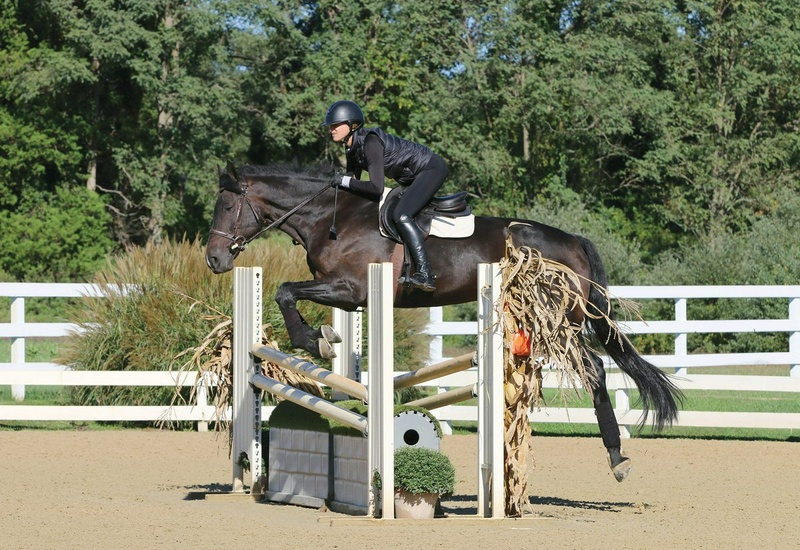
On the eve of an important competition, like the USA Equestrian Talent Search Finals in the East section, I always want to ensure that my students and their horses are well-prepared.
To do this, I create a course that includes questions they are likely to encounter in the competition and then break it down into manageable sections.
The course we are going to practice in this article is adapted from the USA Equestrian Talent Search Finals from a previous year.
Although I cannot predict exactly what will be in this class this time, we may see a form of these questions again.
To prepare for the upcoming USA Equestrian Talent Search Finals, Abby Jorgensen and Klas Heldenlan are doing exercise number 1 and passing through the middle of a Swedish oxer.
©Sandra Olynyk Almost all exercises in this training session focus on rideability.
The main questions will be about the horse's guidance and the ability to lengthen and shorten the horse's strides while maintaining its jumping style.
However, the main goal of this session is to present the exercises in a way that the horses can understand and succeed in them; something that boosts the confidence of both the horse and the rider.
Before addressing the individual jumping exercises, we first do a light warm-up on the flatwork and then a simple jumping warm-up with a few cavaletti to familiarize the horse with some gymnastic elements.
The warm-up on the flatwork, when preparing for a major competition, really emphasizes jumping; therefore, I do not spend much time warming up on the flatwork.
Since the jumping exercises will include questions about guidance and transitioning from a long stride to a short stride and from a short stride to a long stride, I ask my students to practice these on the flatwork in a trot and canter.
It is also important that the horse is ridden from the leg to the hand to establish a good connection and balance; in this case, the horse will have the ability to adjust in its jumping efforts.
Start with a stretched and smooth trot and perform sitting trot on the long sides of the arena, then shorten the stride on the short sides and reach a working trot in sitting position.
To lighten the horse to the leg and inside rein, ask for a few shoulder-ins and then allow it to move forward and straight.
Take the canter and create a slight counter flexion on the long sides of the arena to prepare for the counter canter.
Before the counter canter, we place the horse in counter flexion because this is a good test to ensure the horse is not going to anticipate the flying change.
It should not change its lead just because of how its body is bent.
The change of lead should come from the rider's leg.
Ask the horse to return to an active step to be properly prepared for the counter canter; then execute this movement with a slight bend towards the hand and taking the counter from the inside leg.
The reverse canter exercise is very important because it is one of the tests that riders face in competition.
After about one round of reverse canter, make a reverse turn and return to the correct lead; that is, turn from the inside of the arena towards the outside and then go in a stretched canter on the long side of the arena.
After returning to the counter in the short side, continue the back-and-forth between lengthening and shortening the stride to ensure the horse's stride is sufficiently open and ready for the forward sections of the jumping exercises.
Then change direction and repeat the trot and counter exercises.
When the horse is well warmed up on the flatwork, shorten the stirrups by one or two holes before jumping.
Warming up over the cavaletti helps to guide and collect the horse in the cavaletti exercise, opening its hands; an exercise that serves as a suitable introduction to the more complex gymnastic exercises to follow.
Layout: Place three raised cavaletti spaced 3 feet and 6 inches apart in the center of the arena.
Set up two single vertical jumps with suitable ground lines on the rail.
Objective: This exercise warms up the horse and rider for the subsequent exercises.
Cavaletti are a suitable introduction to the more complex gymnastic exercises that will be performed later.
Additionally, straight and long paths towards single jumps with suitable ground lines, with one jump on each lead, are a good starting point before entering more difficult exercises.
Exercise: On the left rein, pass through three cavaletti in succession at the trot.
Then take the counter, jump the first vertical, make a reverse turn, change your lead, and then jump the second vertical on the right lead.
How to execute the exercise: As you approach the trot cavaletti, open your hands to better adjust the horse's speed and guide it while simultaneously collecting it.
On the trot cavaletti, stay slightly in front of the saddle to avoid falling onto the horse's back.
After the last cavaletti, collect the horse, maintain contact on the outside rein, take the left counter, relieve pressure off the horse's back, and jump the single vertical from within the stride.
The goal is for the horse to be connected on the rein and to have adjustability in the counter.
Then, as you practiced on the flat, make a reverse turn, change leads, and take the long path towards another vertical jump on the right lead.
If the horse is heavy on the rein or becomes quick, stop it in a straight line after the last obstacle.
Exercise 1 Layout: Create a curved line consisting of four obstacles in the center of the arena, with each spaced 64 to 70 feet apart.
This line will be jumped from both directions and includes a Swedish oxer, a wall, a Liverpool, and a second Swedish oxer.
Objective: These curved lines can be approached very straight and in a four-four-four stride pattern, or with a slight curve in a five-five-five stride pattern.
We will take the five-five-five pattern to demonstrate guidance, control, and straightness.
Exercise: First, jump the last Swedish oxer of the line with a long approach to serve as a warm-up obstacle for the horse.
Then start the exercise.
Move left, come along the long side at the counter, and jump the first Swedish oxer; then take five strides to the wall, five strides to the Liverpool, and five strides to the second Swedish oxer.
As you approach the first obstacle from the turn and from the left, when you pass over the Swedish oxer, stay to the right, make a circle in the middle, and then jump the line in the opposite direction and on the right lead.
Riding method: In this exercise, turn with both reins towards the center of the obstacles.
If you rely on release on the mane instead of automatic release, or if you have the bad habit of opening your thumb and placing it on the horse's neck because you can't be independent and guide each step, this becomes challenging.
In this line, the horse does not necessarily have to land on the correct lead; however, if you are on the right path, maintain balance, and ride from the leg, the horse should be able to perform a lead change in the middle of the line.
I like to use Swedish oxers outside the line because riders usually go on an open path instead of collecting the horse to match the number of steps.
If you pass through the path instead of collecting the horse and go too wide, you will end up on the high side of the Swedish oxer and may knock it down.
Remember that if you have to push the horse too much over the Liverpool because it hasn’t jumped it yet that day, collecting it again becomes a bit harder, and the stride to the next obstacle may shorten a bit.
Exercise 2 Layout: Create an outer line with four obstacles.
Place two verticals one stride apart (26 feet), then measure four strides (64 feet) to a Swedish oxer and then four strides longer (66 feet) to the second Swedish oxer.
Place a water jump at an angle towards the end of the arena.
(If the water jump is not jumped, put a Liverpool or a regular oxer instead.)
I like to use striped poles on the verticals because it helps the rider maintain focus on keeping the horse in the center.
Goal: This exercise is a good test to assess adjustability to see how much riders can lengthen and shorten the horse's stride and keep the horse in the middle of the obstacles.
The single stride requires the horse and rider to enter at a specific speed and distance, and the rider must correctly identify the stride both in four strides and again in four longer strides; all while maintaining the line of travel due to the Swedish obstacles.
For this reason, this line is also a suitable exercise for working on automatic release; a technique that is more advanced than release on the mane.
Exercise: This line should be jumped from both directions, starting with a left canter on the verticals of this in-and-out.
Take the left canter and jump the single stride, then reach the appropriate four strides and then four longer strides.
Once you have completed the line once, change direction by passing over the water jump, make a large circle, and jump the exercise from the other side, starting from the Swedish oxers.
In this way, the line is completed as a long four-stride, then a fixed four-stride, and finally a short single stride.
How to execute it: Try to jump from the middle of the obstacles.
Ride through the line with short reins and a strong body position.
On the water jump, have a good release, guide the horse close to the box, and ask him to stretch over it so he doesn't land in the water.
Then quickly check that the reins are short enough to collect and balance the horse for the next obstacle.
The water jump may encourage the horse to enter with a big stride, which can help achieve the longer four strides between the Swedish obstacles.
When entering the fixed four strides and short single stride, use your voice to collect the horse and finish the exercise with a direct and good halt.
This halt reinforces the concept of the request to collect for the horse.
Exercise 3 Layout: Place a cavaletti as a rail on the ground (3 feet 6 inches), then a vertical jump or cross-rail, followed by a single stride (23 feet) to a vertical, and then two strides (36 feet) to another vertical.
Objective: Jumping from the vertical is a common test in competitions that have a gymnastics section; therefore, practicing it is very important, as it can be challenging for horses and riders and requires a lot of balance and precise timing.
The rail placement, which helps with the horse's timing, is the same cavaletti I used in warming up for the jump, as I want the horses to be comfortable going over the raised cavaletti before facing the three obstacles behind it; three obstacles that may cause them anxiety and make them want to rush.
Exercise: Pass over the placed cavaletti and the vertical jump, then counter one stride to the first vertical and two strides to the second vertical.
How to ride it: Approach the vertical jump from the right side.
Keep your upper body tall and upright so your horse waits and stays patient.
For horses that may be cautious or want to rush towards the obstacle and add an extra counter stride, try to have a soft and calm leg to maintain your connection in the vertical.
Try not to interfere with the horse's jump and stay balanced over the second and third verticals.
After landing from the third jump, turn left and go along the long side of the arena, then bring the horse back to the vertical and jump the exercise from the approach on the left side.
After the second time, stop in a straight line.
Horses jump many paths throughout the year during training; therefore, it is good to ask for a straight stop after a line to ensure the horse is listening to you.
Exercise 4 Exercise 4 is a good example of something that could be the first question in a championship competition; this line is designed to be a bit bold to show that riders understand how to move forward and also demonstrate their ability to lengthen and shorten the horse's stride.
Layout: Create an outside line consisting of a vertical jump to an oxer, with a distance of four strides (64 to 66 feet), and then place another vertical jump five strides (73 to 75 feet) from the oxer.
Objective: Often the first question in a championship competition is something that is a bit bold to show that the rider knows how to enter the arena and place the horse completely on the bit.
This is also a good test to demonstrate the rider's ability to lengthen and shorten the strides.
This line can be one of the initial lines in the competition course.
Exercise: Start the work with a counter on the left hand and ride four long strides and then five short strides.
Change direction over the Swedish oxer used in exercise 1, make a circle, and approach the line from the opposite direction.
How to ride it: Adjust your rhythm with an open stride and start with four long strides, then collect the horse's stride to form five short strides.
Pay attention to each stride.
In some strides, the horse may want to stay behind your aids, and you may need to bring it to the bit by adding your leg.
In some strides, the horse may want to pull the reins from your fingers and may need a half-halt.
When you change direction on a Swedish oxer and circle, this should help the horse soften so that you can return balanced and round, with weight on the heels and hands wider for five collected strides.
In the five-stride line, collect in time and a little earlier so that you are forward again in the last stride.
This prepares the horse for the next four long strides and gives it an appearance similar to an invisible adjustment.
Then after the last jump, stop in a straight line.
I like to end the training session when the horse is performing the exercises correctly, but I never want to repeat a movement so many times that the horse becomes tired and fatigued.
Horses usually perform a task better the second time, and that is exactly what we are looking for in this training session.
By practicing these movements, you and your horse will enter the competition course with more confidence and readiness.
See the Stasia Klein Maden collection on Equestrian+ here.
About Stasia Klein Maden Stasia Klein Maden.
Stasia Klein Maden, recognized as one of the most successful trainers of young riders in the country, began her professional career successfully in the junior ranks; she became the national champion of ASPCA Maclay in 1987 and was among the top in the National Medal Finals Hunter Seat USEF and the USEF Talent Search Finals in the East.
She turned professional in 1988 and began her collaboration with Beacon Hill Show Stables; a facility now located in Colts Neck, New Jersey.
Maden also worked for Johnny Barker in North Carolina for a time and then returned to Beacon Hill; where she began teaching and became interested in working with young riders and pairing them with suitable horses.
This article was first published in the Fall 2024 issue of Practical Horseman.
Source: Practical Horseman – Training