13 tips for cross-country training
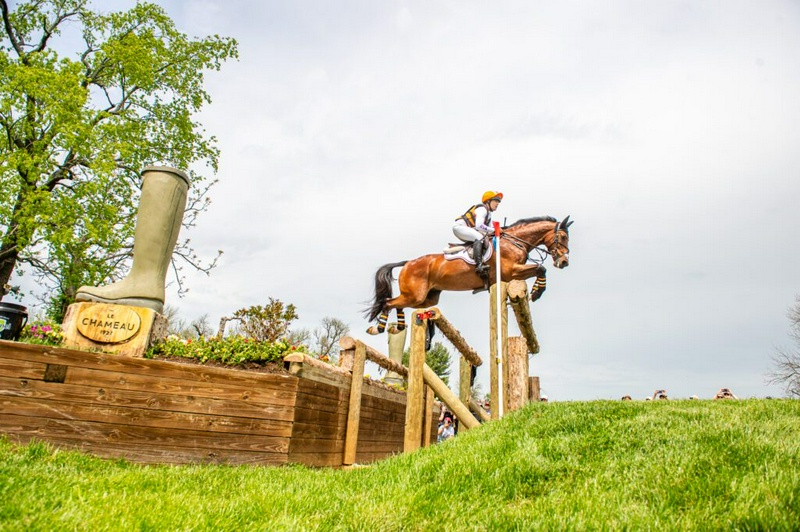
Many of my cross-country training sessions start with the most basic elements: water, a bank, and a ditch.
Understanding these types of questions is a fundamental step in training an eventing horse, and even my advanced-level horses usually start by wetting their hooves or going up and down a small bank.
This helps my horses begin the exercise calmly and slow their minds so they can better understand foot placement over these obstacles.
A calm horse listens, responds better to aids, and has more confidence.
Once I ensure my horse is calm and confident, depending on what each horse needs for training, I increase the jumps and work on the course.
In this article, I will present 13 tips for developing happy, calm, and confident horses; horses that can succeed on the cross-country course both in training and competition.
A calm athlete performs better. A calm athlete, at any age and level, performs better.
If your horse is calm, it will be more successful.
It is your responsibility to put it in that state from the very beginning.
I like to start by having my horses simply walk through the water; going in and out, or up and down a small bank.
I try to make this stage easy, fun, and simple for them.
For horses that are excited from the start, changing rhythm and transitions are your best help; just as it is in the arena.
Calmness is not only about the horse, and you as the rider must also be calm.
It’s natural to feel anxious during cross-country training or competition; who doesn’t?
Sometimes this anxiety makes you want to ride faster to compensate for not feeling very brave, or to take a defensive stance, resulting in excessive speed or too much hand interference; something that is exactly contrary to keeping the horse calm.
The good thing is that you can teach yourself to be calm.
Before important rides, I rely heavily on breathing exercises and meditation.
This helps me focus more, calm my mind, and relax myself.
I really cannot emphasize enough how much this method helps you to calm down and face any anxiety you may feel.
The calmness of the horse is very important for it to perform better, but calmness for the rider is equally important.
I strongly recommend doing breathing exercises and meditation before important rides to focus, calm down, and slow your mind; something that will ultimately help keep your horse calm as well.
Make sure its focus is maintained. Now it’s time to get your horse’s attention.
Look at the horse’s ears: are they fixed forward?
Or do they turn back to listen to you?
Are its eyes bulging and seems distracted by everything?
You need to keep its attention on the task at hand.
To achieve this goal in warming up, my best advice is to perform transitions; also lateral work like leg-yield and shoulder-in.
These exercises make the horse sensitive and focused on your aids; something like a kind of meditation for itself!
When you start jumping, begin with a small and simple obstacle so the horse understands what its job is.
If you have trouble getting your horse's attention after starting the jump, don't be afraid to go back to transitions and lateral work.
Goal setting is important; horses go the way they are ridden.
Know precisely and clearly where you are going and what you want.
This is important.
Your horse should not be in doubt about what you want from him.
The same applies to you.
If you have a clear plan in mind, you will perform better.
But if you are unsure about your plan, you become hesitant, and that is where everything becomes unclear for the horse.
It is the rider who knows where to go; the horse does not know such a thing.
It is your duty to use your aids clearly and distinctly so that the horse understands your direction and desires.
Know your responsibilities; riders have many responsibilities, but in my opinion, these are the main priorities: 1.
Maintain mental readiness – bringing a chaotic or negative mind to riding time is never a recipe for success; that is where things can get out of control and the fruits of your labor can be lost.
The reality is that emotions practically have no place in riding.
Of course, they arise, but it is our duty to manage them and stay present and focused for our horses.
2.
Establish and maintain rhythm – horses look to us for commands, and the commands we give them must be clear.
Establishing rhythm helps the horse maintain its balance.
3.
Guidance – it is the rider who knows where to go; the horse does not know.
You are the one who must take on the role of its leader and, with clear and distinct aids, help it understand the line of movement.
4.
Maintain body position – a stable and powerful body position gives you and your horse confidence and is also very important for safety.
Proceed slowly; to build your horse's confidence, approach cross-country obstacles at a slow speed and a steady rhythm.
Going at a gallop towards the water obstacle to see if your horse is brave makes no sense; because surprise is never a good thing, and you do not want to scare an animal that has an instinctive flight response.
Whether your horse is young or at an advanced level, it should be able to enter the water and come out of it, go up and down banks, and jump over ditches; all at a walk.
If it can do these things slowly and with ultimate calmness, just like a Western Pleasure horse, then it will handle them more confidently as speed increases.
But if your horse cannot do these things calmly and easily, its success at high speed will depend more on luck.
From that point on, everything becomes a gamble; and I prefer to create my own luck through work.
Repetition is the mother of all skills; whether you are practicing water, banks, or ditches, you must show the horse a million times that everything is safe and sound and that it can handle it.
Cross the water, go up and down the bank, or jump over the ditch, then come back and do the same thing again.
Repeat it enough until it becomes boring for him.
This does not mean to continue until the horse can no longer think; rather, it is like any other acquired skill.
Just continue practicing without pressure, and in the end, both you will progress and he will learn that he does not need to strain himself so much.
Continue until you reach the conclusion that this is the simplest and most basic thing you have ever done and do it with complete confidence.
Teach him to place his feet; banks require different physical effort for a horse compared to a jump.
Many horses do not know how to calmly go up and down a bank; that is, they do not know how to place their feet.
You do not want your horse to throw itself off the bank, so you must teach it through repetition not to do that.
Show your horse that this is not a big deal at all and that it can do it easily and calmly.
Start by going up the uphill bank at a walk with a loose rein, as if you are on a leisurely ride.
Your job is to guide it, keep your leg on, and look ahead.
Try not to change your body position or attitude at all, as this encourages the horse to try too hard.
There is no ceremony or excitement involved.
Its job is to step up without stress.
When it goes up the bank, give it plenty of praise.
When going up the bank goes well, come down the downhill bank in the same way.
A ditch is just a counter step; a ditch is one of the simplest cross-country obstacles because it does not require special effort.
Banks require different physical effort, and horses must learn how to handle that.
Water creates resistance, and the horse has to exert more force.
But a ditch is just a counter step.
So why do horses behave strangely about ditches?
Usually because riders behave strangely about ditches.
When horses are learning, they may look at the ditch, but some do not care at all.
And certainly, when they become established and experienced, it is no longer a concern for them.
When practicing the ditch obstacle, first ask your horse to come forward with a purposeful walk and cross over it.
Then turn around and cross over it again from the opposite direction.
Keep the legs active, maintain a soft rein, and fix your gaze on a point in the distance.
Keep your upper body slightly back and stay behind the horse's movement, and keep the horse's legs moving to cross the ditch.
When its confidence and eagerness increase, it is fine to let it come to the ditch at a trot or canter; but if you feel this increase in speed is due to anxiety, without hesitation bring it back to a walk for a few rounds.
Use the company of other horses; if your horse is nervous about water, banks, or ditches, let it follow behind a confident horse.
This creates a positive experience for the anxious horse because horses are herd animals and rely on each other for support.
When the horse successfully crosses the obstacle behind another horse once or twice, ask it to do it alone.
You can keep the accompanying horse at the landing side for a time or two, but eventually, this emotional crutch must be removed.
If your horse is nervous about water or any other obstacle, let it follow behind a confident horse.
This creates a positive experience, and eventually, you can gradually phase out this supportive companion.
Get comfortable with different terrains; it is important to practice riding on different terrains even if you are not jumping.
This topic applies to walk, trot, and canter.
Practicing to become comfortable on different terrains and surfaces is one of the key elements in building confidence and ability.
Ultimately, you will learn how the ground specifically affects your horse and how you can adjust yourself with changes in his balance.
To help build confidence and understand how the ground affects your horse and how you can adjust his balance, even if you are not jumping, practice riding on different terrains.
Give your horse information that is understandable to him; if you feel your horse took an extra step in a combination, this is not necessarily a fault.
Information that is understandable to your horse is to tell him to go forward.
If your horse takes one step in a single-step combination, the only response is to close your leg after landing and say, "Hey, stay in front of my leg."
The opposite is also true.
If he takes one step in a two-step combination, the only response will be, "Oh, slower after landing."
Respect your horse; horses respond very well to positive energy.
You do not need to be perfect at any point, but you should ride your horse with a positive approach; believing that he is doing his best and just as you take pride in your work, he takes pride in his duty.
If your horse becomes anxious or does something unexpected, remember that he is a flight animal and his behavior may become strange.
But you should not become unsettled along with him.
Reassure him that everything is okay.
Focus on him; what is understandable to him and what he needs.
Know when to stop; consider what is in your horse's best interest and how much jumping he should do.
He may be able to jump more, but that may not be what he needs on that particular day.
If you always consider your horse's well-being and prioritize him, you will build a strong partnership and a deep connection with him.
About Sharon White: Sharon White is an international five-star eventing rider, coach, and instructor with a Level 4 ECP certification from the United States Eventing Association, operating at Last Frontier Farm in Summit Point, West Virginia.
White has started in the Kentucky Three-Day Event over 10 times with five different horses.
She has also traveled abroad to compete in the CCI5 events at Luhmühlen and Le Lion d'Angers, as well as the CCI4 events at Boekelo and Hartpury.
She won a team silver medal at the 2023 Pan American Games with Klaus 63.
Recently, White also claimed victory in the second U.S. Open Eventing Championship 2026 with Klaus 63.
Source: Practical Horseman – Training