Margi Engel's strategies for the preparation and endurance of horses
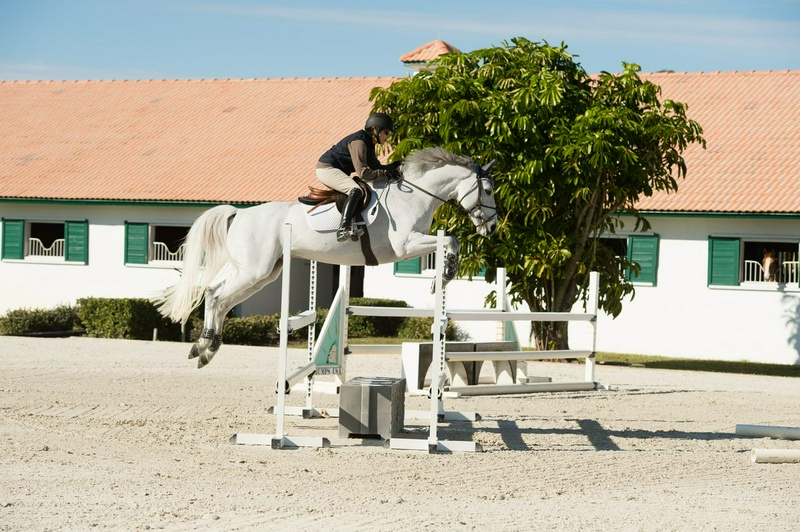
My number one priority has always been the horse.
I am always looking for new ways to extend the athletic life of my horses without them becoming mentally or physically exhausted and unmotivated.
I avoid excessive and repetitive training; not only to prevent unnecessary stress on their legs but also because I want them to approach their work with freshness and an eager spirit.
To stay informed about the latest scientific findings and methods for strengthening and preparing horses while minimizing their risk of injury, I attend veterinary conferences with my husband, Steve Engel, a veterinarian.
I also pay attention to the methods that trainers in other disciplines use.
These are some of the most important lessons I have learned: 1.
Minimize impact stress.
Over time, repeated impacts can lead to injury in the hooves, joints, tendons, and ligaments of my horse.
The higher the jumps, the greater the intensity of these impacts.
Therefore, shorter obstacles are the best choice for training sessions.
2.
Avoid excessive repetition.
Just as repetitive movements in humans can lead to tendonitis, in horses, it can lead to muscular fatigue, resulting in gradual wear on bodily structures.
This can be challenging in sports like show jumping, where some practice is essential for developing and honing the skills of both horse and rider.
If you do not practice at all, you and your horse may lack the strength and timing needed to perform at your best without jeopardizing your health.
So there is a very fine line in this regard.
Some practice is necessary, but you should change the program before your horse experiences pain or boredom.
3.
Target the whole body.
Focusing too much on one part of the body ultimately leads to compensation in other areas.
For example, if you constantly ask your horse to land on a specific lead, the muscles on one side of its body may become fatigued.
To compensate, it will try to shift the load to the other side of its body.
Many cases of lameness arise exactly in this way.
The stronger your horse's entire body is, the less risk of injury it will have.
So choose exercises that engage both sides of its body equally while also strengthening the abdomen, back, neck, and other areas.
4.
Use interval training and complementary training.
Eventing riders are particularly skilled in interval training.
They know how to raise the horse's heart rate, maintain the intensity of the exercise for several intervals, and then reduce the pressure to bring the heart rate back down.
Gradually increasing the number of these interval "sets" improves overall strength and fitness.
I also incorporate Chaharnal into the regular program of my show jumping horses; not only to improve their step adjustment and comfort in this movement but also to increase their respiratory capacity.
Dressage is an excellent complementary exercise and is a very good way to improve the horse's obedience and responsiveness.
All horses should learn basic dressage.
If you can reach a more advanced level, gradually introducing more collected movements into your show jumping horse's program will strengthen different muscle groups compared to what it typically uses.
When Lisa Wilcox, the Olympic dressage rider, rides my horses, it feels like I have sent them to a gym; she makes them work more from their hindquarters in short, repetitive sets and asks them for something akin to the equine equivalent of a squat movement in humans.
5.
Work on different surfaces.
Riding on varied terrains — sandy arenas, grass arenas, outdoor trails, hills, and even hard surfaces — strengthens different structures in the horse's body and gets them accustomed to performing on various types of footing.
This is also very beneficial for the horse's mental health.
6.
Whenever possible, repeat exercises in both directions.
Horses' brains do not work exactly like ours.
When you perform an exercise and then approach it from the opposite direction, it seems to the horse as if it is seeing it for the first time.
If you can execute a lesson in both directions, you will always get the most benefit from it.
I design my training sessions considering all these principles.
Below are three exercises that I use to keep my horses' programs fresh and effective.
Exercise 1: Football Grid Setup: Place four poles 3 to 3.5 feet apart from each other and at one end of each pole, place an adjustable cavaletti support; so that the cavalettis are arranged in an alternating angled manner.
Start with poles that are either completely on the ground or at their lowest height.
This exercise reminds me of tires that football players pass through to improve agility and coordination.
This exercise strengthens the top line of the horse's body, engages its hindquarters, increases the suspension of its movements, teaches it to regulate its rhythm of movement, and enhances its awareness of its foot placement.
At the same time, it improves the line of movement and enhances the connection between the rider's leg and the horse.
To set up this grid, you can use any equipment that allows you to raise the cavaletti from only one side.
I have boxes that I can rotate to create different heights (6 inches, 8 inches, 10 inches, and 12 inches).
If your jump standards have holes at about 6 inches or lower, they can also be used.
Place three or four poles about 3 to 3.5 feet apart — and up to 4 feet for larger horses — and put a block or base next to each pole.
In the first few passes over the grid, place both ends of the poles on the ground so that they are simply regular trot poles.
Approach them with an active and collected sitting trot.
(The sitting trot is ideal because it gives you the most control over the rhythm and forwardness of the horse and provides the best feel of what the horse is doing underneath you.
But if you are not yet comfortable in a sitting trot, a light trot is also perfectly suitable.)
Keep your legs well down and around the horse's sides to feel the work of its hindquarters and back.
Imagine sending its hind legs forward while simultaneously creating more suspension in its steps to move energetically towards the poles.
In the trot, go straight through the middle of the poles, then change direction, make a circle, and pass through them again from the other side.
Once again, change direction; this time turn towards the opposite side after the poles; that is, if you turned the previous circle to the left, turn this one to the right so that in the end you ride in a pattern resembling the number eight on them.
Focus on a very precise path: stay completely straight during the approach line, while crossing over the poles, and then make soft turns with appropriate bending.
Use the end of the arena to maintain the highest degree of straightness each time you approach this exercise.
If your horse is nervous or tries to rush over the poles, bring it back to a walk, remove one or two poles (from the beginning and/or end of the row, so that the distance between the remaining poles is still 3 to 3.5 feet), and walk very slowly and deliberately over the remaining poles.
This teaches it to step between the poles.
When it performs this part well, return to a trot and approach the poles with a very calm and controlled manner.
After a few successful repetitions, put the removed pole or poles back in place.
Once it is comfortable with the ground poles, raise one end of each pole alternately; so that one end remains on the ground and the other end is elevated with a block or base, at the lowest height.
For example, raise the first pole from the right side, the second pole from the left, and continue in this manner.
Approach this row in the same way and, if possible, do this while sitting in the trot.
Maintain your connection with your legs and hands so that your horse understands it still needs to step over the poles, not jump over them.
Repeat this exercise several times in both directions, encouraging it each time it does it correctly and allowing enough time for walking between repetitions.
Then, if it seems really comfortable with the exercise, raise the ends of the poles to the next height.
In the first session, do not exceed a height of 8 inches.
If its first experience was good and it worked with confidence and coordination, you can start the next session from where you left off and, if desired, gradually increase the height and/or add more poles.
Also, if you feel secure in the saddle, do this exercise a few times without stirrups.
The more familiar your horse becomes with this exercise, the more you should clearly feel that its energy is being transferred from your legs to a good connection in your hands.
Each time you pass through the poles, try to find an optimal balance between your legs and hands.
If it slows down and falls behind your leg, ask yourself if you have used your hands too much.
If it becomes flat and quick, ask yourself if you have used your legs too much and your hands too little.
You should never be rough with either your hands or legs; rather, you should maintain a light and gentle connection with both to create and support a good and steady rhythm.
At the same time, you will feel that by lifting your legs over the poles, more spring and bounce is created in the horse's back.
This is the lift and suspension that you should feel; and exactly the propulsion and "stored spring" that we want for jumping.
When you achieve a good connection over the poles, you can also perform this exercise in a light trot.
Make sure to ask the horse to collect and maintain suspension during each repetition of the exercise.
Remember not to repeat the exercise too much.
When it seems that your horse has understood the exercise, just repeat it a few more times and then move on to something else.
Then incorporate this exercise into your flatwork; for example, work on lengthening and shortening the stride in other parts of the arena and in between jumps over the poles, lateral work, transitions to canter, and similar tasks.
1.
I approach the poles at a collected canter.
I usually start this exercise at a sitting canter to have the most control over rhythm and speed, but with Alter Ego, owned by Leah Allen, I use a light canter because he is naturally active and energetic from behind and is already familiar with this exercise.
2.
This is a good example of how the poles help improve the connection between your leg and hand.
I have made it difficult for Alter to lengthen his stride by overusing my hands and not using my legs enough.
As a result, he enters the exercise a bit shallow.
His front hoof is close to the first pole on the ground, not where I want it: in the middle of the distance between the first and second poles.
3.
This time, the problem in passing through the exercise is the opposite: I have used my legs too much and not enough with my hands; the small loop on my reins shows this.
As a result, Alter opens his stride too much and tries to jump over the cavaletti.
4.
Finally, we reach the correct connection.
He steps almost flawlessly between the poles, bending his hocks and knees very well and lowering his head and neck forward; thus, he uses his back and top-line muscles effectively.
Here, I can really feel the movement and suspension in his strides.
5.
When Alter seems ready, we raise the cavaletti to the next height, which is 8 inches, and if that goes well, we raise it to 10 inches.
From the beautifully arched top line of his body, it can be seen that he engages the muscles of his neck, back, and hindquarters to lift his legs higher over the poles, resulting in a more suspended and elongated movement.
6.
In the end, we raise the cavaletti to their maximum height, which is 12 inches, and adjust them.
Notice how much he bends his joints and uses his top line.
This is a great and low-pressure way to strengthen his muscles.
Exercise 2: Bounces Layout: Create three vertical jumps and place a ground pole on either side of each; the distance between each jump should be 9 to 10 feet.
Like the previous exercise, this one is also very useful for improving alignment and rhythm; at the same time, it sits the horse more on its hindquarters and makes the front end react faster.
It also helps him adjust his jumping arc correctly over the top of the obstacles.
This exercise teaches the horse to learn from its mistakes and to collect itself over the obstacles so that it neither passes through the appropriate jumping point nor gets too close to the obstacle when taking off.
In the meantime, you can also focus on your own body position and balance.
Only perform this exercise with an experienced horse that is already familiar with bounce jumps.
Arrange three small crosses with a distance of 9 to 10 feet apart.
Instead, you can create each jump as a single pole; in such a way that one end is raised and the other end is placed on the ground like in exercise 1.
If you and your horse are more experienced, turn the jumps into small verticals, but do not exceed a height of 2.5 feet.
If the horse naturally has a larger stride, increase the distance between the jumps to up to 11 feet.
Place a ground pole on either side of each jump.
This helps the horse better understand the distance and prevents it from passing the appropriate jumping point.
Approach the fences with a collected canter and make sure the horse moves in front of your leg.
In this exercise, it is better to be a bit closer to the obstacle than to lean too far forward.
When you reach the first jump, release it so it can focus on its work.
The less you interfere, the better.
Throughout the exercise, maintain your two-point position so the horse can jump up and you can close your leg angle over each obstacle.
If it gets quick over the fences, stay a bit behind the movement with your body and gently slow it down using your weight — not your hands.
Jump the fences in both directions.
When this part goes well, you can gradually add one or two more jumps.
If you have a young horse and want to enter the exercise at a trot instead of a canter, place a guide pole 7 to 8 feet from the first jump to help it reach the obstacle from a comfortable take-off point.
Then place a second guide pole 9 to 10 feet after the last jump.
With this setup, jump the exercise only in one direction; so that the trot pole is at the beginning of the path, not at the end.
1.
The first time we go through this exercise, we remove the pole of the third vertical jump and only keep the two ground poles next to each other in place.
We approach this single bounce with a collected but lively canter.
When Alter locks his gaze on the first obstacle, I wait for him to jump up towards me.
2.
I remain calm and still in the saddle, keeping my gaze up and my hands soft and following his mouth so he can solve the exercise himself.
3.
At this moment, Alter prepares himself for the next jump: his hands have reached the ground from the landing of the first jump and have lifted off the ground again, while his hind legs are just about to land.
He engages the hind part of his body, positioning his limbs in this collected and compact form.
4.
When he confidently jumps the second vertical and focuses on the next ground poles from that moment, I do not interfere with him and let the obstacles themselves do the work, not my hands.
5.
Now we build the third vertical jump.
I approach the grid with the same canter and remain calm and still while he passes through the exercise with a bounce.
He is learning to engage his hind body for landing and immediate take-off from the ground.
From the expression on his face, it is clear that he is fully focused.
The arch of his neck and back and the muscular wave along his belly indicate that this exercise is "gymnastizing" his entire body.
6.
Now, by raising one of the cup bases on one side of each vertical jump, we make the grid visually more appealing; so that that side has two holes higher than the lower side and the obstacles are angled alternately; similar to a football grid exercise.
I bring Alter to it in the same way with a canter and then let him go to do his own work.
Exercise 3: This in-and-out layout: Place a vertical obstacle and a square oxer 21 feet apart from each other and put ground poles on both sides of each obstacle.
To help maintain the horse's alignment, place two ground poles perpendicular to the line of obstacles between jumps; initially, the distance between these two should be 10 to 11 feet.
This final exercise still emphasizes the line of movement while helping you focus more on body control and reminding the horse to collect more when taking off for the jump and to shift more weight onto the hindquarters.
Place a small vertical obstacle 21 to 22 feet away from a small square oxer.
Put ground poles on both sides of both obstacles.
Add another pair of ground poles in the middle of the exercise and perpendicular to the obstacles to create a straight corridor for the horse to canter through.
Some horses may spook or be afraid when first encountering these poles; therefore, initially place them 10 to 11 feet apart.
Approach this in-and-out with a working canter and first head towards the vertical obstacle to the oxer.
At this distance, the passage should be comfortable, although you may need to engage your leg more after the vertical obstacle to ensure the peak of the horse's next jump is right over the center of the oxer.
When your horse jumps this in-and-out well in this direction, approach it from the opposite side.
The distance may feel a bit tighter in this direction; therefore, after helping him with your leg to cross over the oxer, remain steady in the saddle and allow him to understand the exercise.
Let the obstacles gather him.
Help him more with body control than with your hands; that is, open the angle of your hips and keep your upper body a bit longer and more vertical.
Change directions several times in this exercise to feel the different needs of riding from the vertical to the oxer and from the oxer to the vertical.
At the same time, if your horse has trouble staying straight, gradually bring the ground poles closer together until the distance between them is about 8 or 9 feet.
If his drifting problem is serious, arrange these poles at a gentle angle in a "V" shape and bring the ends of the poles slightly closer together in front of the take-off point of the second obstacle; but no less than 3 feet.
At this stage, only jump this in-and-out in this direction; or ask someone on the ground to reset the "V" shape each time so that the narrow end always points towards the second obstacle.
If you are a more experienced rider and this exercise is going well, practice it without stirrups and/or tie the reins together and place your hands on your hips or spread them to the sides like airplane wings while crossing the obstacles.
This will help you gain more independence from your hands and focus more on your body position and balance in the air.
Remember that the horse's welfare should always be a priority.
Keep training sessions fun and varied, without overdoing it; so that both of you are eager for the next turn.
1.
First, we approach this in-and-out with a working canter, heading towards the vertical obstacle to the oxer.
While crossing over the vertical obstacle, I follow Alter's mouth movement with my hands in the air while keeping my eyes on the oxer.
2.
After landing from the vertical obstacle, I tighten my leg and continue to encourage him softly and steadily to move forward in the counter.
I try not to disturb his work and let him focus on the obstacles, not on what I am doing.
As a result, he adjusts himself in such a way that .
.
.
3.
.
.
.
delivers a good and compact jump over the oxer.
Next, we go to the vertical in the counter.
4.
This distance is covered more tightly in this direction, but without my interference, Alter assesses the situation and adjusts himself correctly to make an excellent jump out of the vertical obstacle; he lifts his knees well and pushes off powerfully from his hindquarters.
Didrim Didrim and Margie Engle clear a 7.5-foot wall in a indoor competition.
I discovered the benefits of football grid training (training 1) with Didrim; a horse I have been riding since he was 5 years old.
In a way, he and I grew up together: I won my first grand prix and my first major grand prix at the American Grand Prix Association with him.
He was a very large and somewhat leggy horse who moved lightly on his feet, but he jumped like hunter horses with a short and low stride; close to the ground and with very little knee movement.
He needed to learn to act faster on very square oxers, which is why I consulted with Vince Dugan, a seasoned horse trainer and seller.
Vince was one of the many generous professionals who advised me in the early years of my career when my budget was tight and I was eager to learn, providing me with both advice and a horse to ride.
He suggested I try this exercise to teach Didrim to think more about his feet and to collect his front end faster at the moment of takeoff.
This exercise worked!
After that, we achieved victories together in countless grand prix events and several classes of the wall, clearing walls taller than 7 feet!
I continued competing Didrim until he was nearly 20 years old, and then I saw him spend another decade in happy and comfortable retirement.
About Margie Engle Margie Engle has been one of the most decorated show jumpers in America for over three decades.
As a child, she cleaned dog and cat kennels in exchange for riding lessons until she was deemed big enough to clean stalls and take on the role of a groom.
She did not have her own horse until her late 20s.
In the meantime, she learned all aspects of horse care and riding and gradually worked her way up to the highest level of the sport.
To this day, Margie has won over 200 grand prix classes, 6 World Cup qualifiers, over 20 Nations Cups, and holds the record for 10 titles of "Rider of the Year" from the American Grand Prix Association.
She competed in the 2000 Olympics, won a team silver medal at the 1999 Pan American Games, achieved team gold and individual bronze at the 2003 Pan American Games, and also earned team silver at the 2006 World Equestrian Games.
Last year, she was the anchor rider for the champion team at the British Columbia Nations Cup with Royce, a 13-year-old Oldenburg, and then led the field in the grand prix final of the Etko Nations Cup with a prize of $130,000.
Margie, who has once again demonstrated her ability to extend the presence of her horses in competitions, now has 2 18-year-old horses competing at the FEI level: Bokmans Lazio, who has already secured several top 10 placements this year, and Indigo, who placed third in the NetJets CSI**** Grand Prix this February at the Winter Equestrian Festival, with 2 clear rounds and a prize of $205,000.
Margie and her husband Steve Engle, a veterinarian with whom she has shared her life for 23 years, are based at Glidwinds Farm in Wellington, Florida.
Source: Practical Horseman – Training