Gymnastics Practice 1 for Working with Cavalletti
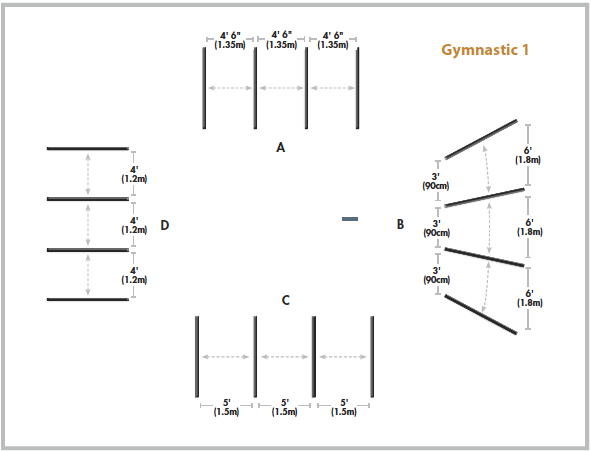
Gymnastics 1 is designed to familiarize the horse with a regular passage over the poles placed on the ground.
Dressage horses can also benefit from this initial exercise, as there are no jumps involved.
Here, your focus should be on the rhythm of the horse's trot and the calmness and regularity of its steps while passing over the cavalettis.
The horse should pass over the ground poles with relaxed back muscles and without tension, and its head and neck should lower slightly to adjust its stride for reaching the next pole.
The four undefined exercises that make up Gymnastics 1 can easily fit in a manege measuring 75 by 150 feet (22.8 meters by 45.7 meters).
After warming up the horse in walk, trot, and canter, enter the exercise marked with A in the diagram at a trot.
The cavalettis arranged at this distance create a trot exercise for most horses.
All these exercises are designed for horses that have some jumping experience.
If your horse is very inexperienced, it probably shouldn't attempt this exercise yet.
However, if the horse is a bit inexperienced or is considered an experienced jumper but hasn't done much work over cavalettis, you can move the first and third poles closer to the centerline of the manege.
In this case, a 9-foot (2.7-meter) distance is created between the two poles.
Horses find this exercise easier and quickly achieve stability and regularity in their trot; something that is always your goal.
Then you can place all four poles together as shown in the diagram and work over each of the four ground poles in both directions.
Once you have stabilized the horse's balance and rhythm in this section, you can move on to the curved poles in exercise B.
In sitting and rising trot, pass through B on a circle in both directions.
Adjust the horse's direction so that its stride length on the curved path feels the same as when passing through A.
When you and the horse become skilled at this, you can, for example, enter from a point closer to the end of the 3-foot (90-centimeter) poles; where the distance is shorter, and then allow the horse to move away from the center of the circle at an angle.
This will cause the horse to transition from working trot to medium trot or even, if the angle becomes too steep, take a few extended trot steps.
If the horse takes two steps between the poles or goes to canter, you have probably asked it for more flexibility than it can manage.
In this case, aim closer to the end of the 3-foot (90-centimeter) curved path and re-enter B in sitting and rising trot.
Another way is to enter from the outer side of B; where the distance between the rails is greater.
In this case, the horse initially takes a relatively large step.
Guide the horse towards the 3-foot (90-centimeter) distance between the last two poles.
This brings the horse back to working trot, or even a slightly collected trot.
Once you have completed this exercise in both directions, including being able to enter from both sides at an angle, you can move on to exercise C.
The poles positioned in C create the feeling of an extended trot, and you may notice that your horse does not have enough stretch in the fourth stride to clear the last pole and is forced to take an extra step.
In this case, simply remove the last pole and continue the exercise.
You will see that after a day or two of working on the cavaletti, your horse will understand the purpose of the exercise and you can put the fourth pole back in place.
You should work in both directions on the poles that are spaced 5 feet (1.5 meters) apart, so your horse can maintain its rhythm and stride length.
After a short break, go to exercise B.
These poles on the ground, spaced 4 feet (1.2 meters) apart, create a collected trot.
Although this exercise can be done in both a sitting trot and a light trot, you must use the light trot until your horse gets used to them.
Using a light trot, instead of a sitting trot, encourages the horse to lift its back as it lengthens its stride.
Additionally, the exercise will be easier for you and allow you to focus on the horse's cadence instead of getting caught up in your own sitting position.
Again, perform this exercise in both directions through D so that your horse becomes calm and stable in its balance and rhythm.
The horse should be able to pass over the poles without any interruption in its movement and only change its stride length to match the different distances you have set in its path.
After another break, you can now connect these four sections to create various transitions; transitions that are very beneficial for teaching flexibility to the horse.
For example, work in a trot from the right into A; where the distance between the poles is 4 feet and 6 inches (1.35 meters).
When you exit A, turn right, creating a curve at B, and have your horse change its stride from the working trot to the collected trot.
In other words, start exercise B from the outside to the inside.
This will place your horse in a slightly more collected frame.
Then go straight to C, which creates the extended trot.
After the extended trot in C, turn right and enter the shorter cavalettis in D.
If your horse has trouble in this section, you can perform A, B, and C as I have explained, and then, in a light trot, make a circle — or repeat the circle enough times until your horse returns to the working trot — then change direction and enter D to create the collected trot.
If you successfully complete this step, walk, reward your horse, and allow it to relax and think about its effort while you plan for the next round of these exercises.
When you resume the sitting trot, perform the exercise in both hands and vary the ratio of exercises to improve and stabilize your horse's flexibility.
Pause for a moment and remind yourself of your horse's bad habits.
If the horse tends to rush in the trot, you do not need to repeat this excessively at C.
It should come in from the outside to the inside at B instead of coming from the inside to the outside; because this will help it constantly regain its balance and collect its strides, rather than rushing forward.
If, on the other hand, your horse has short and disconnected strides or is lazy, a little more emphasis and a few extra repetitions in B, moving from the inside to the outside, will teach it to lengthen its stride.
The total time spent doing this exercise on these poles in each session should not exceed 45 minutes, including rest times between exercises.
Sources and Appendices: Modern Gymnastics: Systematic Training for Jumping Horses Source: Practical Horseman – Training