The impact of the rider's shoulder position on the hand and contact with the reins
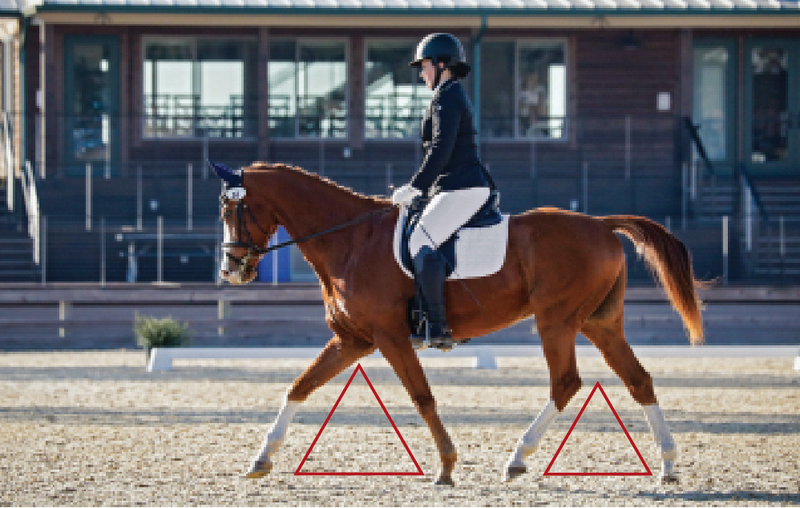
In this photo, Tessa Davis is competing at the training level with her 17-year-old Dutch cross gelding, Shadowfax.
Tessa has written that she is currently training at the first and second levels.
Tessa Davis rides her 17-year-old Dutch cross gelding, Shadowfax, at the training level.
Megan Banj Shadowfax looks light and harmonious, with long legs and a well-proportioned and coordinated body.
For the training level, he is in good form.
What stands out is his willingness and eagerness to respond to his rider's aids.
A bit of tension is visible in his back — in the saddle area — an issue that has caused his hind leg to come up more from the back than from the hip joint.
When I look at the distance between his front legs, it seems that an open and suitable triangle has formed between his two front legs and the distance of his hooves on the ground (according to the photo above).
When I compare this triangle with the triangle formed by his hind legs, I see that the latter is slightly narrower and the distance between his hind legs, that is, the stride length, appears shorter.
In a balanced sitting-rising trot, we expect the stride lengths of the front and hind legs to be closer and more equal.
This does not mean that Shadowfax is inactive.
This moment simply shows that there is some tension in his back that has caused the stride to shorten.
When I look at Tessa, my first impression is that she is a very compassionate rider.
She tries to sit lightly and keep her legs extended while her heels are down and her hands are also down.
It is clear that she does not want to interfere with her horse.
This photo was likely taken in a sitting-rising trot, just at the moment she was settling down.
This explains why her upper body is slightly leaning forward.
The next point that draws attention is that her hands are positioned a bit too low.
The classic line from her elbow to her hand and then to the horse's mouth is not straight.
The low position of her hands breaks this line, and her elbow also appears almost straight.
When I closely examine Tessa's arms, I see that her upper arm is not very long.
Her elbow joint is positioned almost in the middle of her upper body.
The length of the upper arm varies from person to person.
The placement of the elbow joint determines how much angle the rider needs in their elbow to create the correct line to the horse's bit.
The shorter the upper arm, the straighter the elbow joint needs to be positioned.
There is also a bit of tension in Tessa's shoulder area, which may cause her to move her hands along with her body.
As a result, in the sitting-rising trot, her hands move slightly up and down with her body.
Tessa has kept her hands a bit low to keep them steady.
She does not push her hands down and does not restrict the horse's form, but she does not support the horse's forward movement enough.
Merely correcting Tessa's hand position will not resolve this fundamental issue.
If she just holds her hands higher, it is likely to result in more stiffness and higher tension.
Tessa needs to open her shoulders and learn to feel that the reins extend not just from her hands to the horse, but that her entire arm is also part of the reins and contact.
This mental image can be very helpful: imagine you are riding with a snaffle bridle and a continuous rein; the inside and outside reins are actually part of a single rein that moves in a circular motion.
The circle of contact starts from one hand, travels along the rein to the horse's mouth, goes through the bit in the horse's mouth to the other side, then returns through the rein to the rider's hand, from there it continues to the arm and shoulder, and then through the shoulders along the rider's back to the other shoulder, and from there back down along the arm to the other hand.
The final image is that the rider carries a version of the horse's bit between their two shoulders as well.
To maintain a soft and elastic contact, the rider must be soft and flexible at all joints: fingers, wrists, elbows, and shoulders.
Also, think about the muscles that extend from the shoulders to the spine; these muscles form the basis of the arm's position to be both elastic and under control.
Elasticity must be stabilized at both ends.
To stretch and create length, one end must be securely fixed.
For example, I can only pull an elastic band when one end is secured and I extend the elastic part.
To apply this idea specifically in riding, the rider must control their shoulders so that their arms can act with an elastic and forward movement and they can feel a steady contact with the horse's mouth.
However, to do this effectively, they actually need to move their shoulders.
This is more complex than simply raising and lowering the shoulders or pulling them back, as what helps establish coordination between the shoulders and hands is more of a rotational movement.
Try this: imagine the strap of a backpack is around your shoulder.
This strap symbolizes the path of the shoulder rotation.
If you move your shoulders in the direction of this strap, around and forward, it causes your hands to drop.
If you rotate your shoulders in the opposite direction, it helps you hold your hands better.
If the rider learns to activate this small rotational movement with each step of the horse, riding with better hand position and a light, forward, and elastic contact will become easier for them.
Try this other exercise for a better understanding of soft and elastic contact: if you hold the rein only between your thumb and index finger, you suddenly get a very clear sense of direct connection with the horse's mouth.
This exercise helps you feel that your arms constitute 50 percent of your rein, and to maintain a steady and soft contact, you must move the elbow and shoulder joints.
Once this elastic contact is established, you must learn to move your hands without disrupting this contact.
The rhythmic movement of the hands up and down, or slightly opening and closing the hand position, can improve the horse's lightness and self-carriage within this contact.
Ultimately, you will learn to coordinate the rein aids with the horse's movement and the rhythm of the steps.
This is essential for maintaining balance, both for you and your horse, while moving forward.
When I first ask riders to move their hands up and down, I often encounter incredulous looks, as we have been told many times that the hands should be calm and still.
But being calm does not mean being static, and the correct body position is learned from movement.
When you perform this movement correctly, the reins slide on the bit ring and contact with the horse's mouth is not disrupted.
In many cases, the horse prefers a hand that moves with rhythm to a stiff and rigid hand, becoming lighter.
Over time, this visible movement of the hands should be reduced to very small, upward and forward movements.
This teaches the rider how to hold the hands correctly and teaches the horse self-control.
I am sure that Tessa and Shodofix can use these ideas and incorporate them into their training.
Anything that helps elasticity helps the older horse stay young!
About Susanne von Dietze Susanne von Dietze is a leading figure in equestrian biomechanics.
She is a physiotherapist, licensed Trainer A coach, and a judge in dressage and show jumping, and she gives lectures and seminars worldwide, including at the prestigious German Riding Academy in Warendorf.
She is originally German and now lives in Israel with her husband and three children, where she competes internationally.
She is the author of two books on equestrian biomechanics: Balance in Movement and Rider and Horse, Back to Back.
This article was first published in the Spring 2020 issue.
Source: Practical Horseman – Training